

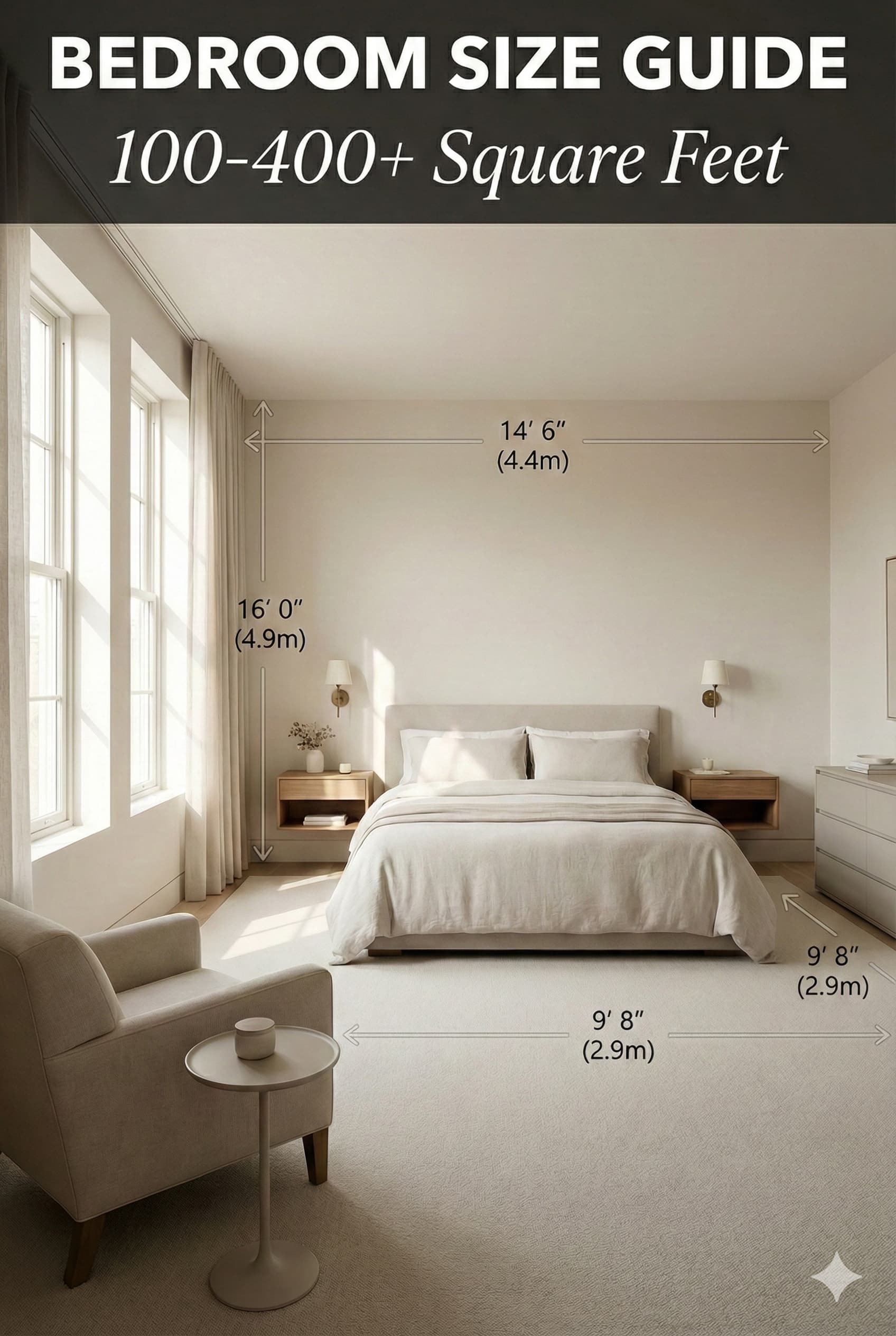
Let me guess: You’re wondering if your bedroom is “big enough” for what you want to do with it, right?
Here’s the real answer, and it might surprise you: Bedroom size matters way less than how you use the space. I’ve seen 100-square-foot bedrooms that feel spacious and 250-square-foot master suites that feel cramped. The difference? Smart layout decisions.
That said, knowing standard bedroom sizes helps you set realistic expectations. Let’s break down what you’re actually working with.
SINGLE PERSON BEDROOM: 100-120 SQUARE FEET
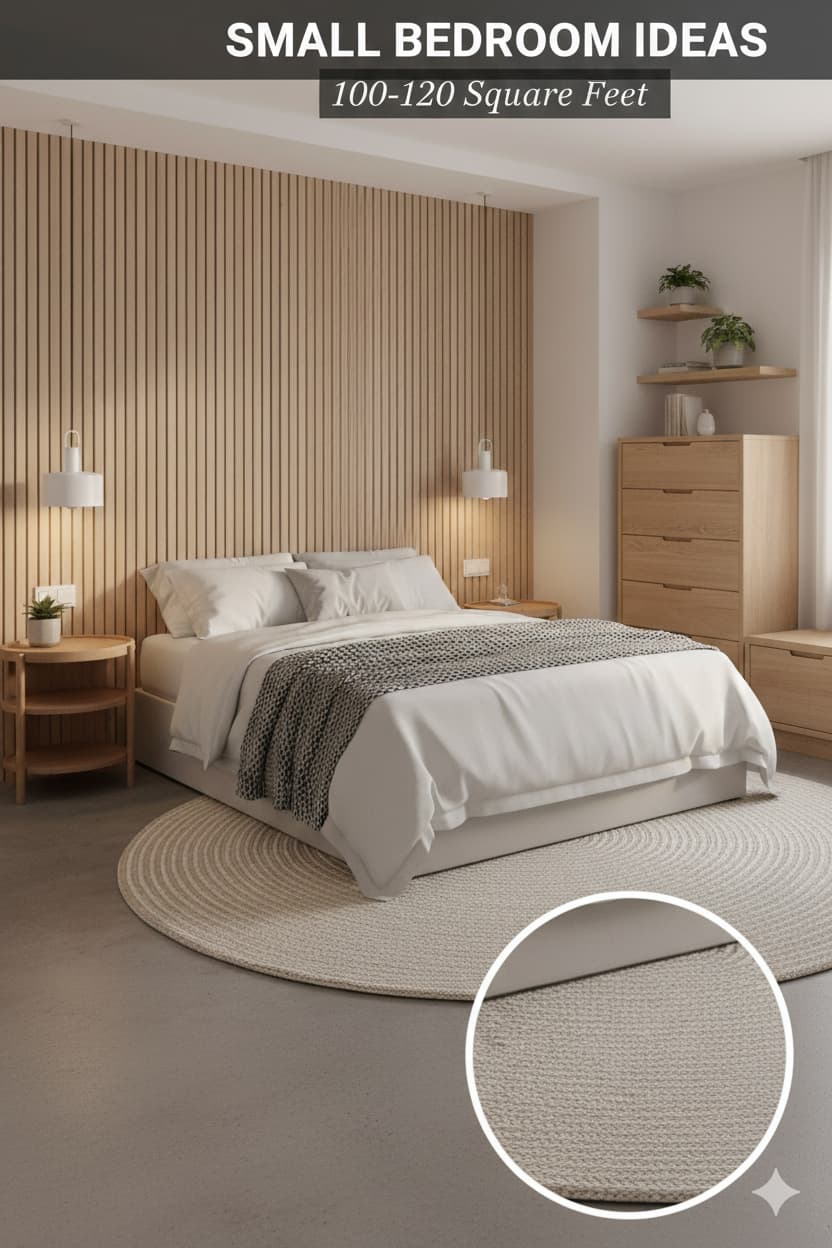
This is roughly 10×12 feet, enough for a full or queen bed, one nightstand, a small dresser, and about 24 inches of walking space around the bed. Cozy? Yes. Unlivable? Absolutely not, if you design it right.
What fits comfortably:
– Full bed (54×75 inches) or queen bed (60×80 inches)
– One nightstand (24 inches wide maximum)
– Wall-mounted lighting instead of floor lamps
– Dresser (36-48 inches wide) or closet organizer system
What doesn’t fit:
– King bed (you’ll have zero circulation space)
– Desk setup (not enough wall length)
– Separate seating area
– Large dresser plus nightstands on both sides
The key here is choosing between dresser storage OR double nightstands. Both won’t work without the room feeling stuffed.
COUPLE’S BEDROOM: 150-200 SQUARE FEET
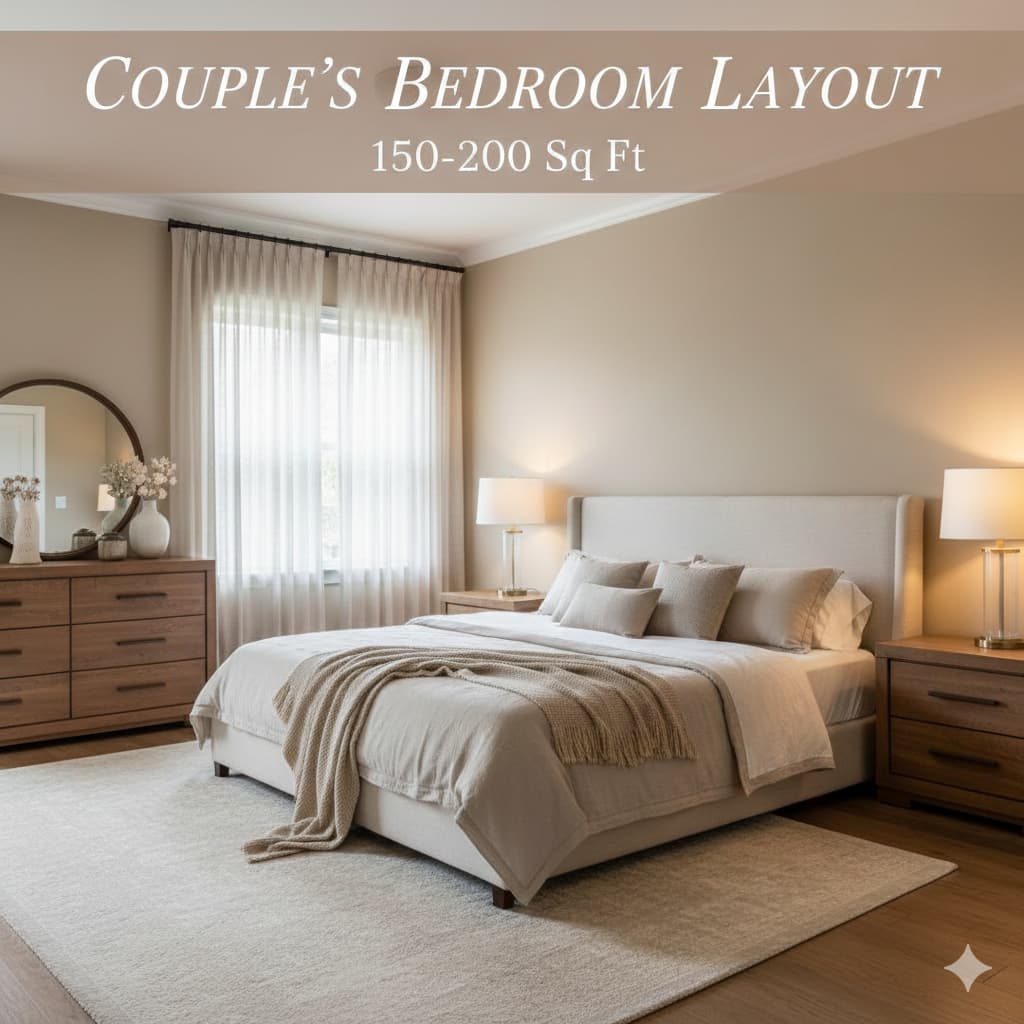
Think 12×15 feet or 14×14 feet. This accommodates a queen or king bed, two nightstands, a dresser, and proper walking space. This is the minimum size where a king bed actually makes sense.
What fits comfortably:
– King bed (76×80 inches) with proper clearance
– Two matching nightstands
– Dresser or chest of drawers
– Reading chair if you skip the dresser
– Floor space for yoga mat or getting dressed
The standard bedroom size in most newer homes falls into this category. It’s enough space to feel comfortable without being excessive.
MASTER BEDROOM: 200-300 SQUARE FEET
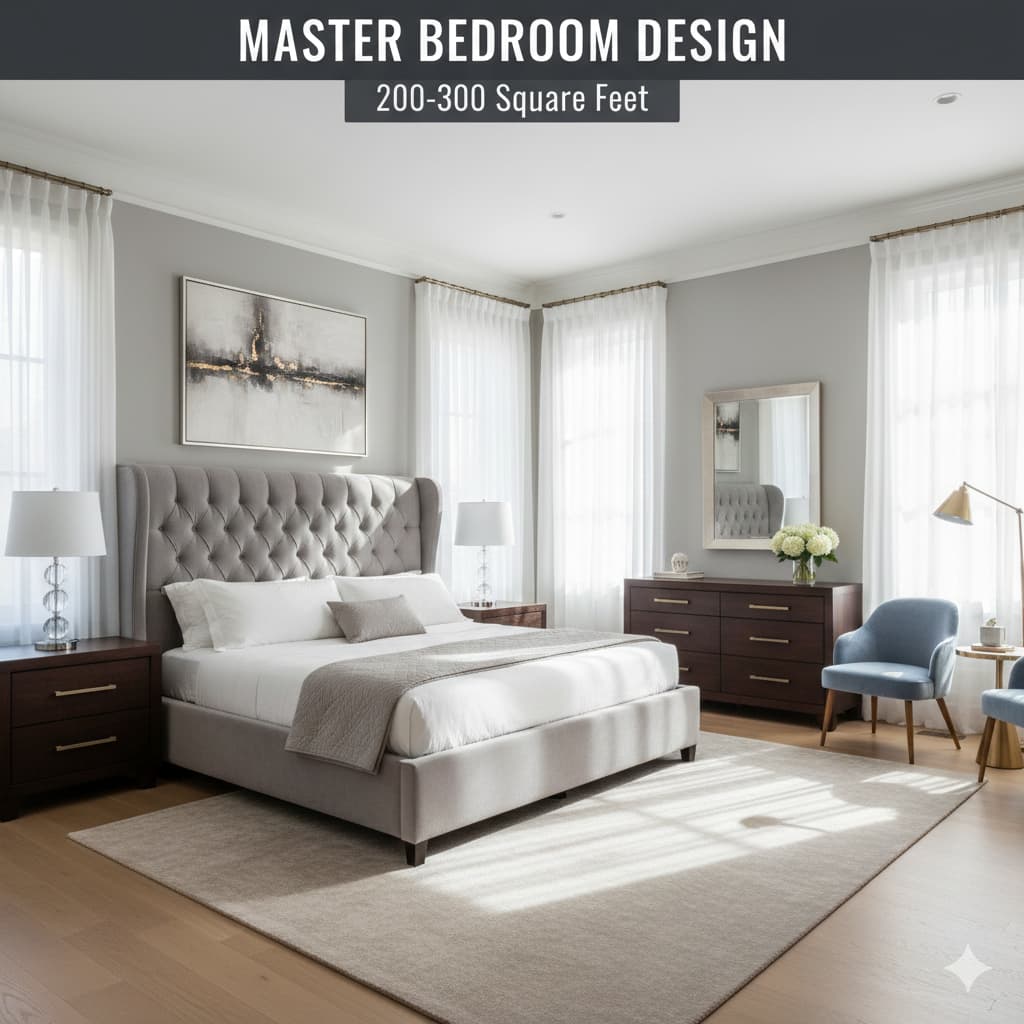
Usually 14×16 feet to 15×20 feet. Now we’re talking about a proper master bedroom where you can add personality beyond just sleeping and storage.
What fits comfortably:
– King bed with generous clearance
– Two nightstands with table lamps
– Dresser or chest
– Small seating area (two chairs or a loveseat)
– Full-length mirror
– Bench at foot of bed
– Dedicated getting-ready zone
LUXURY MASTER SUITE: 300-400+ SQUARE FEET

This is 16×20 feet and up, often with separate zones for different activities. At this size, you’re designing a multi-functional space, not just a bedroom.
What fits:
– King or California king bed
– Complete bedroom furniture set
– Sitting area with sofa or chairs
– Work desk setup
– Walk-in closet entrance
– Separate dressing area
– Reading nook by window
Functional space allocation depends less on total square footage and more on maintaining proper clearances. Professional designers follow specific spacing minimums regardless of room size, which creates comfortable movement patterns and prevents that cramped feeling even in smaller bedrooms.
Bedroom Type | Square Feet | Dimensions | Bed Size | Key Furniture |
Single Person | 100-120 sq ft | 10×12 ft | Full or Queen | 1 nightstand, small dresser |
Couple | 150-200 sq ft | 12×15 or 14×14 ft | Queen or King | 2 nightstands, dresser, chair |
Master Bedroom | 200-300 sq ft | 14×16 to 15×20 ft | King | Full set, seating area, bench |
Luxury Suite | 300-400+ sq ft | 16×20+ ft | King/Cal King | Multiple zones, walk-in closet |
CRITICAL CLEARANCES (NON-NEGOTIABLE):
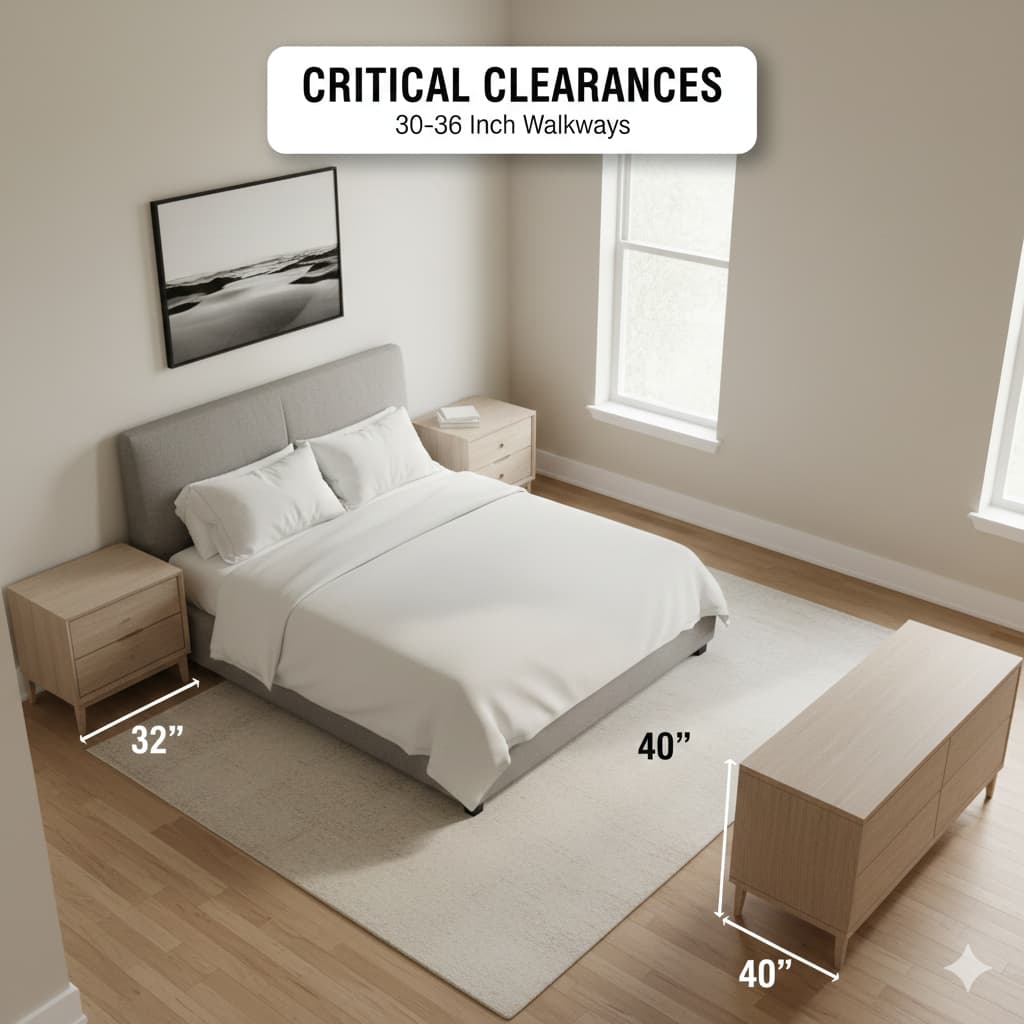
Main walkway beside bed: 30-36 inches minimum
This is your primary path from door to bed. Less than 30 inches feels tight and makes moving around furniture difficult. If you’re constantly bumping into your nightstand, this is probably why.
Foot of bed clearance: 36-48 inches
You need space to make the bed, walk past it, and open dresser drawers. Skip this and you’ll hate your layout within a week. This is the number one clearance that people mess up in small bedrooms.
Dresser access: 36 inches in front
Any less and you can’t fully open drawers or stand comfortably while getting dressed. Measured from dresser front to nearest obstacle (bed, opposite wall, door swing).
Door swing clearance: 32-36 inches
Your door needs to open fully without hitting furniture. Sounds obvious, but you’d be surprised how many bedrooms have dressers positioned where the door can only open 90 degrees instead of the full 180.
Closet door clearance: 30 inches minimum
For sliding doors, you need standing space in front. For hinged doors, you need the door swing plus 24 inches of access space. Bifold doors need about 30 inches to fully open and access items on side walls.
Small bedroom space planning requires precision furniture sizing and strategic multi-functional furniture selections. Each furniture piece must justify functional contribution through cramped undersized furniture arrangements creating disproportionate environments while oversized furniture in appropriate spaces appears disproportionate and fails to adequately support activities.
Living room measurement protocols begin with documenting room dimensions using digital laser measuring devices or traditional measuring tapes. Record length and width measurements at multiple points across rooms, as construction variations create dimensional inconsistencies averaging 1-2 inches in residential structures. Measure ceiling heights from floor to ceiling surfaces, documenting variations from standard 8-foot or 9-foot ceiling heights.
When measuring for furniture placement, always measure in multiple directions. Width, depth, and height all matter. That dresser might fit against the wall lengthwise, but if it’s too deep, your bedroom door won’t open properly.
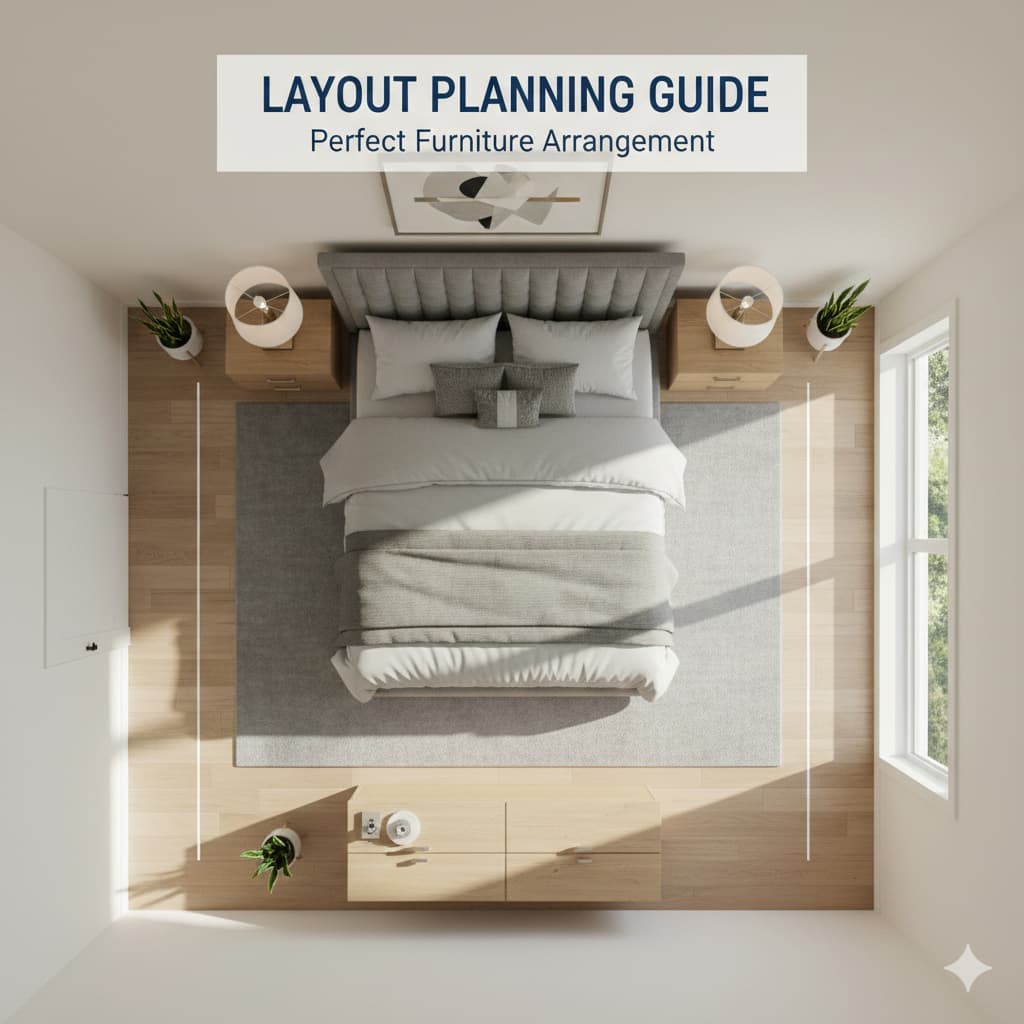
Okay, so you know your room size. Now comes the part where most people mess up: actually arranging the furniture.
I’m going to be straight with you – there’s no “perfect” bedroom layout that works for everyone. But there are proven principles that make any layout function better. Follow these, and you’ll avoid the common mistakes that make bedrooms feel awkward or unusable.
BED PLACEMENT (START HERE ALWAYS):
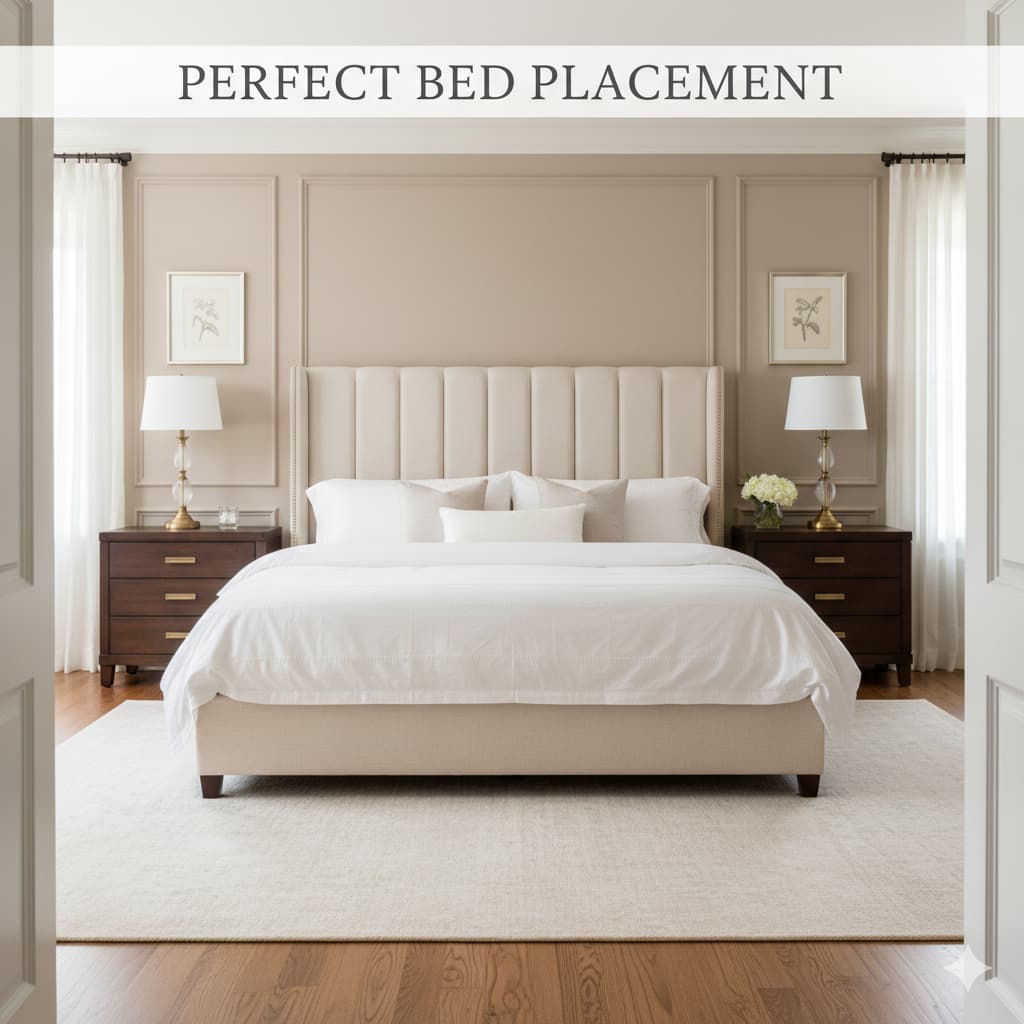
Your bed is the anchor. Everything else arranges around it. Position this wrong and nothing else will work right.
Primary wall placement (most common):
Place your bed centered on the longest uninterrupted wall. This creates visual balance and maximizes usable floor space on either side. Your bed should be the focal point when you enter the room, not hidden behind the door.
Why this works: Walking into the room, your eye immediately goes to the bed (the main purpose of the space). Side clearances stay consistent. Symmetry creates a calm, organized feeling.
Window wall placement:
Some people love waking up to natural light. Others hate it. If you’re placing your bed under or near windows, invest in blackout curtains or cellular shades with side tracks that actually block light. Half-measures don’t work here.
Pros: Natural light, view, romantic aesthetic
Cons: Temperature fluctuations near windows, light control challenges, limits artwork options
Corner placement (small rooms):
Floating your bed in a corner maximizes floor space in tiny bedrooms. You lose one nightstand, but you gain significant functional area.
Works best when: Your room is under 120 square feet, you sleep alone, or you need floor space for something specific (workout area, desk, reading chair).
Angled placement (statement rooms):
Turning your bed at a 45-degree angle in a corner creates drama and visual interest. But it only works in rooms 14×14 feet or larger, otherwise you lose too much functional space.
When to use: Large master bedrooms where you want to create a luxurious, hotel-like vibe. Never do this in small bedrooms, it’s a space disaster.
NIGHTSTAND POSITIONING:
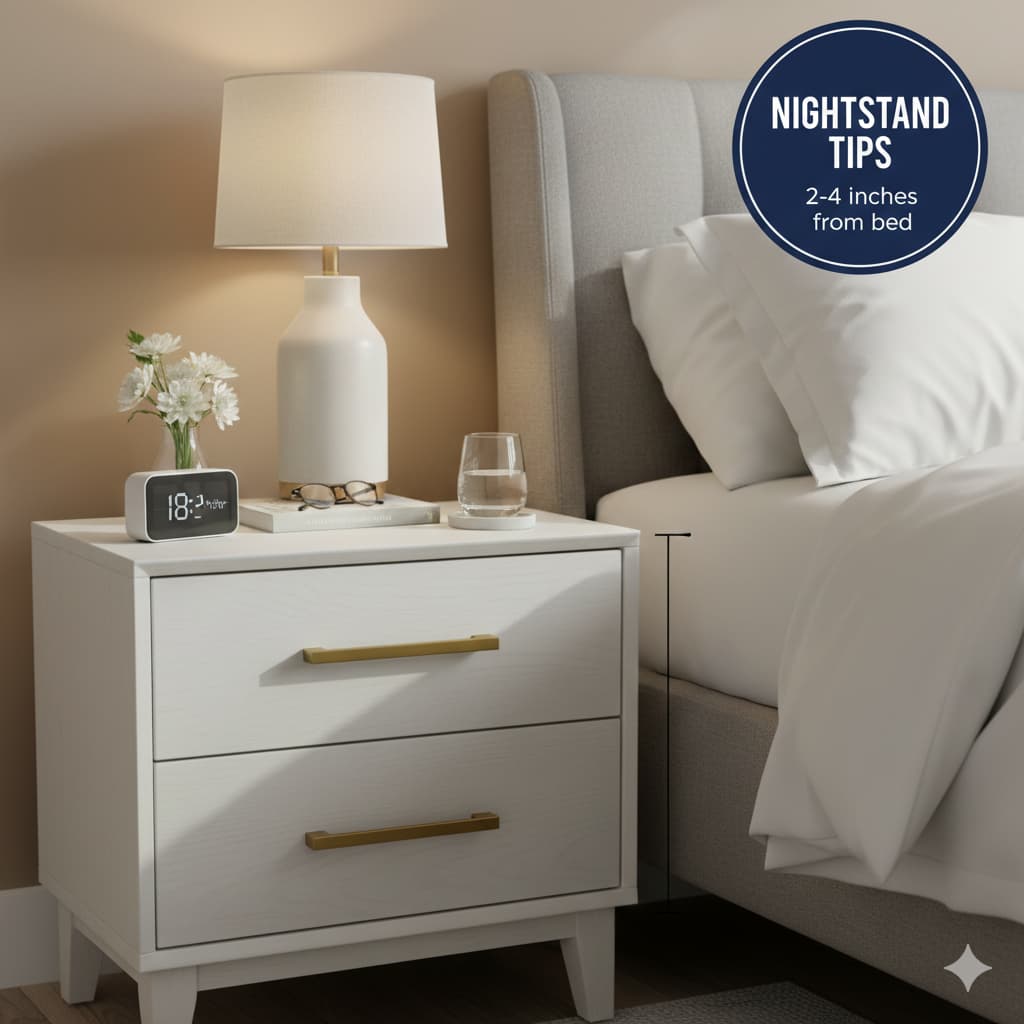
Standard setup: One nightstand on each side, 2-4 inches from the bed. This creates symmetry and gives both sleepers their own surface for phone, water, book, whatever.
Height guideline: Nightstand top should be level with mattress height or 2-3 inches lower. Higher looks awkward, lower means you’re reaching down constantly at night.
Small bedroom solution: Wall-mounted floating shelves replace floor-space-eating nightstands. Add a small wall sconce above each for reading light. You save 12-18 inches of floor space per side.
DRESSER PLACEMENT STRATEGY:
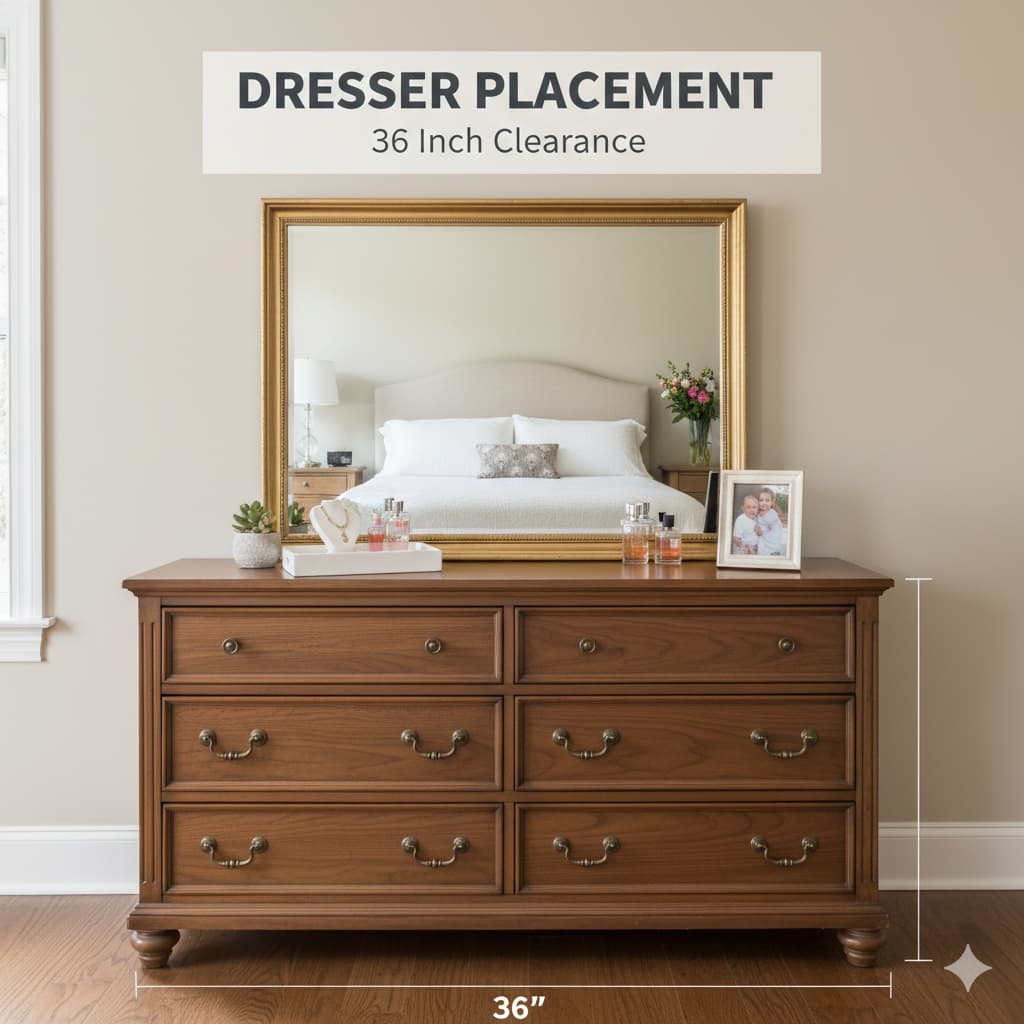
Opposite the bed: Classic position that creates visual balance. Make sure you have 36 inches of clearance in front for drawer access.
Adjacent wall: Works when the opposite wall has windows or doors. Position it where you can see yourself in a dresser mirror from the bed (useful for outfit checks).
Inside closet: If your bedroom is tiny (under 120 square feet), consider a closet organization system instead of a bedroom dresser. You eliminate furniture bulk from the room entirely.
ADDITIONAL FURNITURE (IF SPACE ALLOWS):
Seating area in master bedroom:
Two accent chairs with a small side table create a reading or coffee area separate from the sleeping zone. Minimum space needed: 6×8 feet of floor area. Position this near a window if possible.
Bench at foot of bed:
Provides a place to sit while putting on shoes, holds extra blankets, breaks up the visual expanse of a king bed. Width should be 60-75% of your bed width. Too wide looks bulky, too narrow looks like an afterthought.
Desk or vanity:
If you’re working from home or need a getting-ready station, allocate a corner or wall section at least 4 feet wide. You need 36 inches of depth including chair clearance.
LAYOUT MISTAKES THAT RUIN BEDROOMS:
Blocking natural light pathways: Placing tall furniture (armoires, dressers) in front of windows makes rooms dark and cramped. If your only option is window-adjacent furniture, keep it under 36 inches tall.
Creating narrow walking paths: That 18-inch gap beside your bed? You’ll hate it. Bump it up to 30 inches minimum or accept that you’re eliminating that side access entirely.
Ignoring door swing: Your door hits your dresser when opening? That’s a daily annoyance that compounds over time. Move the dresser or consider a different bed position.
Furniture pushed against all walls: This works in tiny rooms, but in larger bedrooms it makes the space feel disconnected. Float your bed 12-18 inches from the wall in rooms 14×14 feet or larger. It creates a more intentional, designed look.
Traffic flow through the bedroom should establish efficient patterns connecting entry door to bed, bed to closet, bed to bathroom (if ensuite), and closet to dresser. Primary circulation path typically runs along one side of the bed connecting main entry point to sleeping area and continues toward secondary room functions including bathroom access or closet entry.
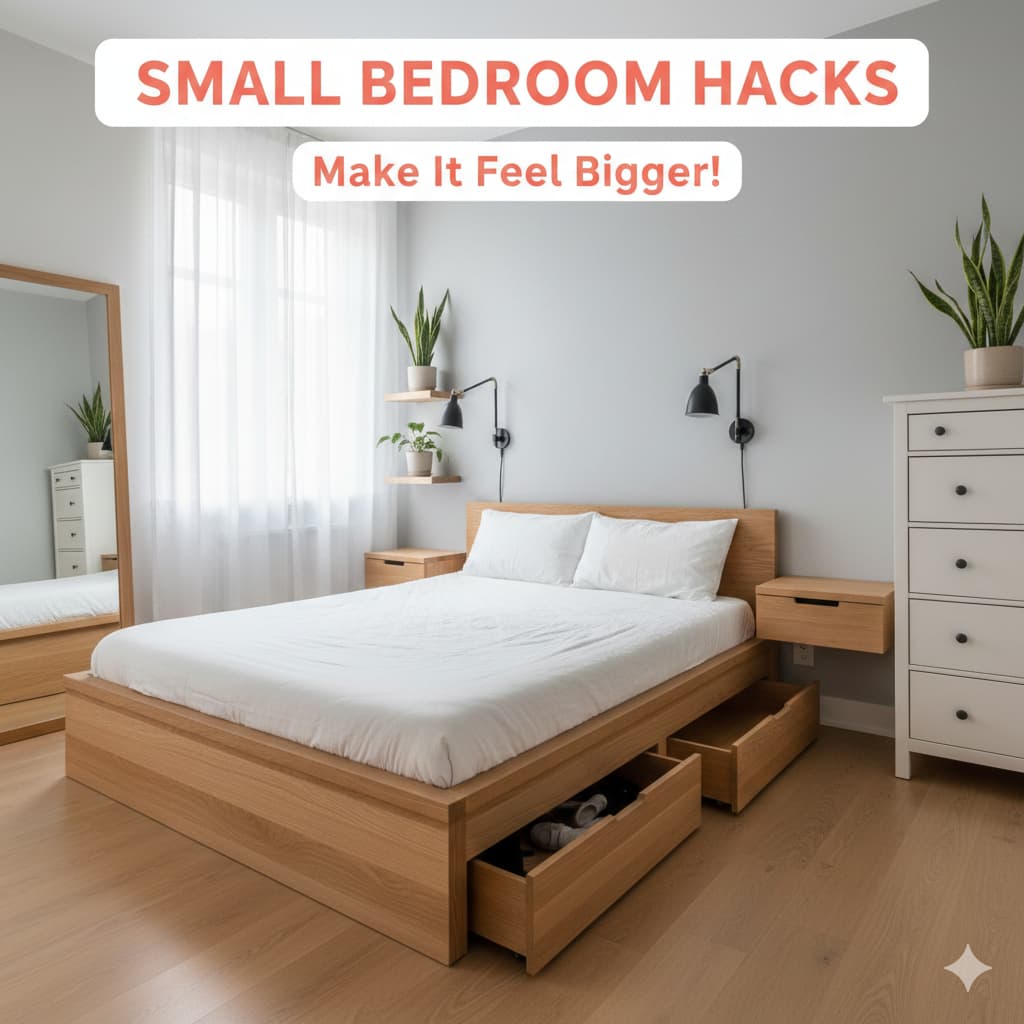
Got a small bedroom? Let’s be real – most of us do. The average bedroom in newer homes is about 132 square feet (11×12 feet). That’s not tiny, but it’s not exactly spacious either.
Here’s what nobody tells you: Small bedrooms often function better than large ones because they force you to be intentional about every design choice. No room for junk furniture or decorative pieces that serve no purpose.
I’ve designed plenty of small bedrooms, and these are the strategies that consistently work.
BED SIZE DECISIONS:
Full bed (54×75 inches): Best choice for solo sleepers in rooms under 10×12 feet. You’ll actually have space for other furniture instead of a cramped king bed with no nightstands.
Queen bed (60×80 inches): Works in rooms 10×12 feet and up. The most versatile bed size for couples in average bedrooms. Six extra inches of width compared to a full, but still manageable in smaller spaces.
King bed in small room? Only if your room is at least 12×15 feet. Otherwise you’re sacrificing all functional space just to say you have a king bed. Not worth it.
VERTICAL SPACE UTILIZATION:
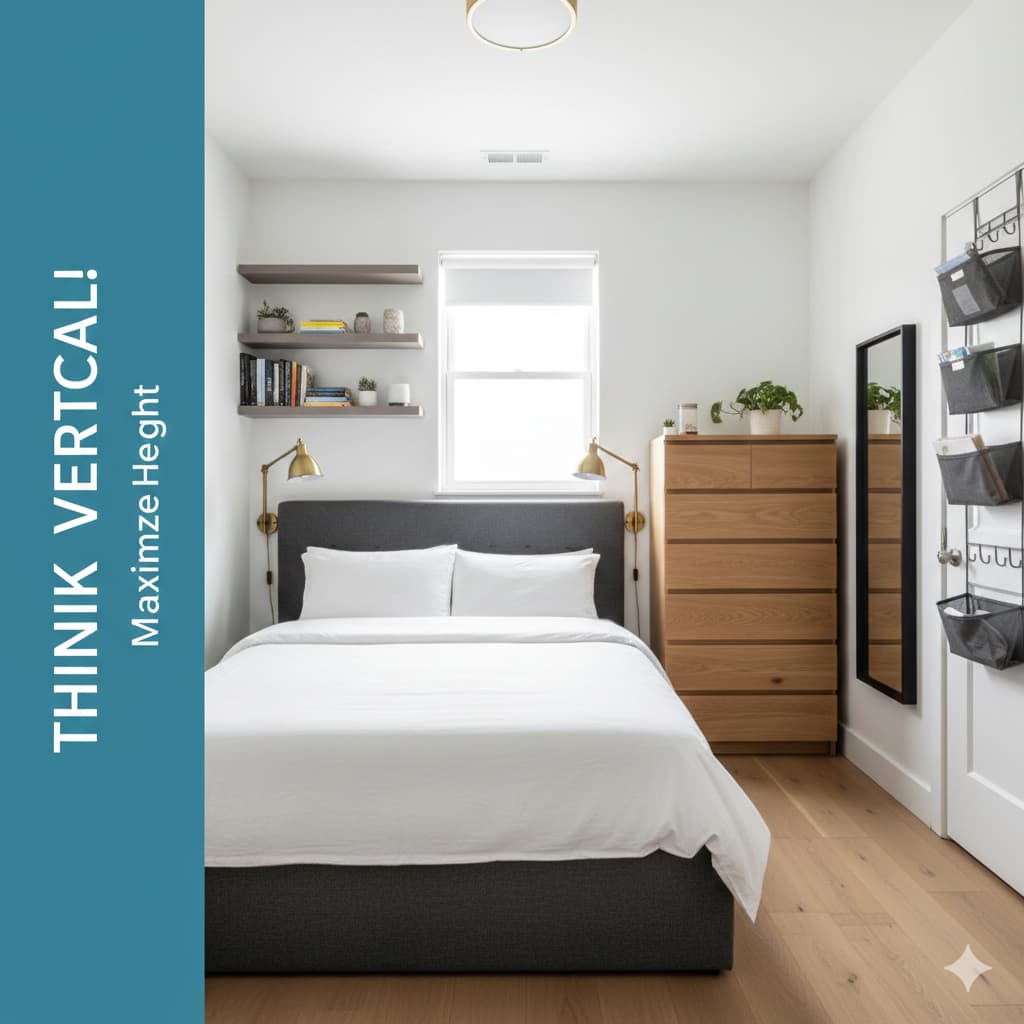
Tall dressers over wide ones: A 5-drawer vertical dresser (36 inches wide, 18 inches deep, 54 inches tall) has the same storage as a 10-drawer horizontal dresser but uses half the wall length. This frees up space for nightstands or seating.
Wall-mounted storage: Floating shelves above nightstands, wall-mounted bedside lights, hanging organizers inside closet doors. Every vertical surface is an opportunity to eliminate floor furniture.
Over-door storage: That space above your bedroom door? Add a shelf. Perfect for storing extra bedding, off-season clothes, or items you need but don’t use daily.
FURNITURE CHOICES THAT MAXIMIZE SPACE:
Platform beds with storage: Built-in drawers underneath eliminate the need for a dresser. Measure first though – you need 10-12 inches of platform height for meaningful drawer depth.
Nightstands with drawers: Instead of open shelves, choose enclosed storage nightstands. Keeps visual clutter hidden, provides actual functional storage for items you want bedside but not on display.
Corner furniture: Corner shelving units, corner desks, corner vanities – all these maximize awkward spaces that don’t fit standard furniture layouts.
VISUAL TRICKS THAT CREATE SPACIOUSNESS:
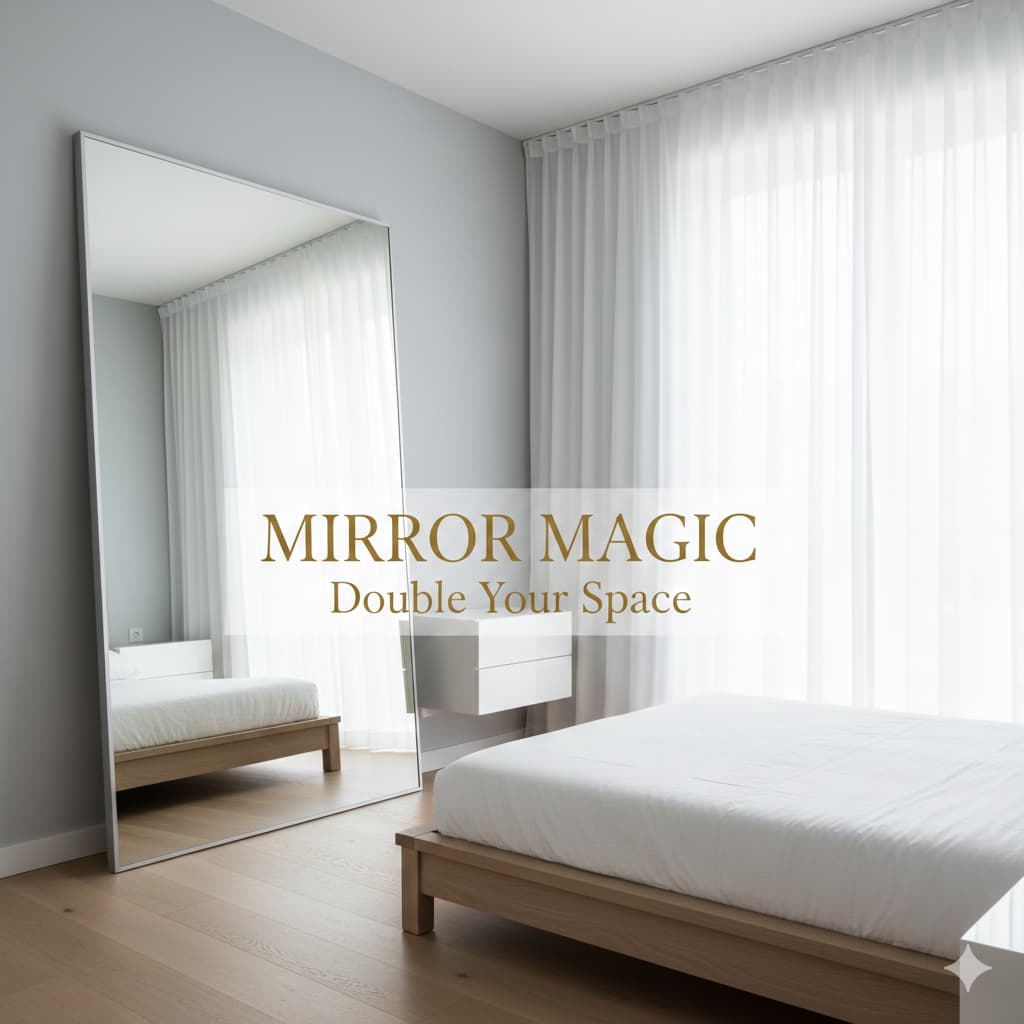
Light colors on walls: White, soft gray, pale blue – these reflect light and make walls appear to recede. Dark colors can look sophisticated but they absolutely make small rooms feel smaller.
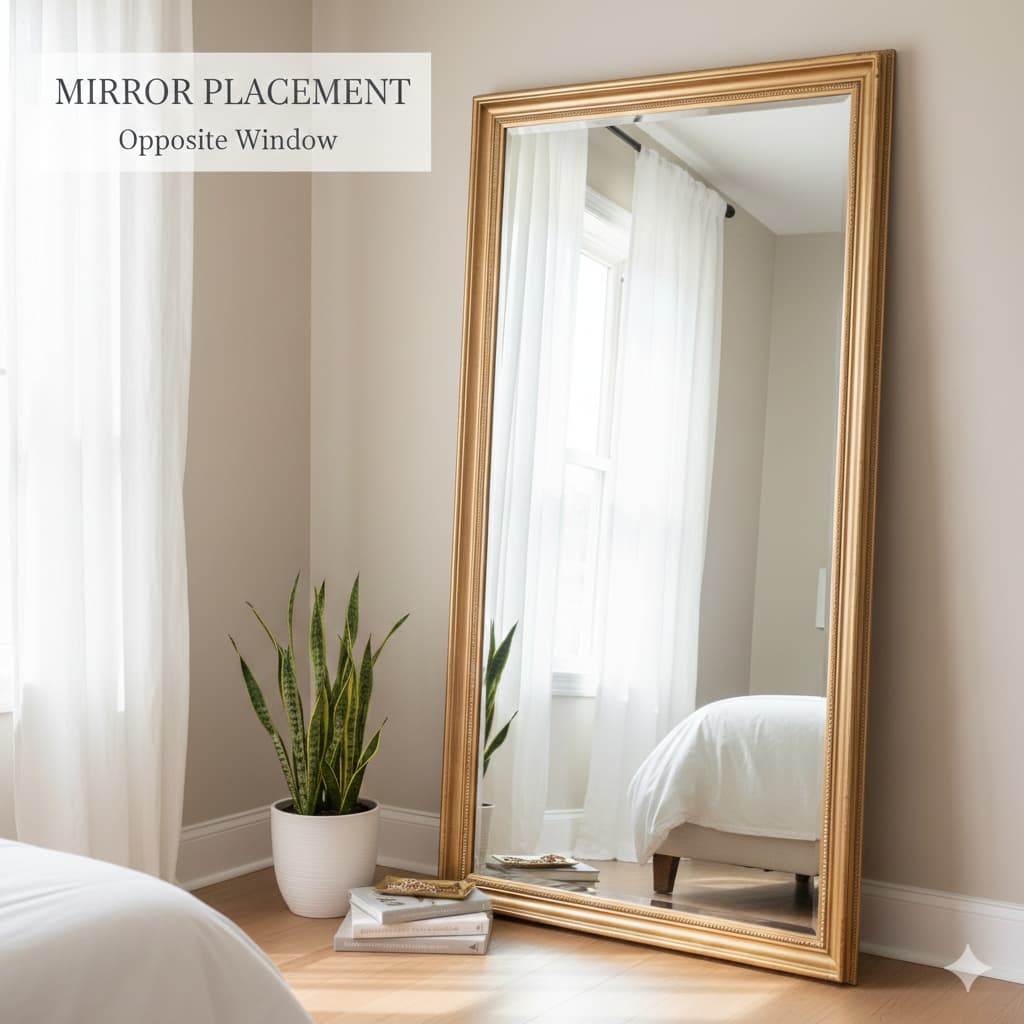
Mirrors opposite windows: Reflects natural light and creates visual depth. A full-length mirror or large decorative mirror positioned to catch window light effectively doubles your perceived natural light.
Minimalist window treatments: Skip heavy drapes that eat up visual space. Simple roller shades or sheer curtains maintain privacy while feeling lighter and less imposing.
Consistent color palette: Using the same or similar colors for bedding, curtains, and walls creates continuity that makes the space feel larger. Too many contrasting colors fragment the space and make it feel busy.
SMALL BEDROOM FURNITURE LAYOUTS (SPECIFIC EXAMPLES):
10×10 bedroom (100 square feet):
– Full bed against center of longest wall
– One nightstand (bed pushed slightly off-center)
– Tall 5-drawer dresser on opposite wall
– Wall-mounted lighting
– No floor space for additional furniture
10×12 bedroom (120 square feet):
– Queen bed centered on longest wall
– Two small nightstands (20 inches wide maximum)
– Dresser on shorter wall
– 24-inch clearance path beside bed
– Just enough room for a small chair in corner if you skip the dresser
11×13 bedroom (143 square feet):
– Queen bed centered
– Two standard nightstands (24-26 inches wide)
– Dresser opposite foot of bed
– 30-inch clearances on both sides
– Small bench at foot of bed possible
Spatial planning in small living rooms requires precise furniture sizing and strategic multi-functional furniture selections. Each furniture piece must justify functional contribution through purposeful placement, as cramped undersized furniture arrangements create disproportionate environments while oversized furniture in appropriate spaces appears disproportionate and fails to adequately support activities.
WHAT NOT TO DO IN SMALL BEDROOMS:
King beds in rooms under 12×15 feet (you’ll regret it)
Bulky bedroom furniture sets with oversized pieces (they’re designed for large master bedrooms)
Multiple large pieces on same wall (visual weight makes room feel smaller)
Dark paint on all four walls (one accent wall okay, all four is too much)
Lots of small decorative items on surfaces (creates clutter that shrinks space)
Small bedroom success depends on ruthless furniture editing combined with smart visual design choices. Every item must earn its place through function, not just aesthetics.
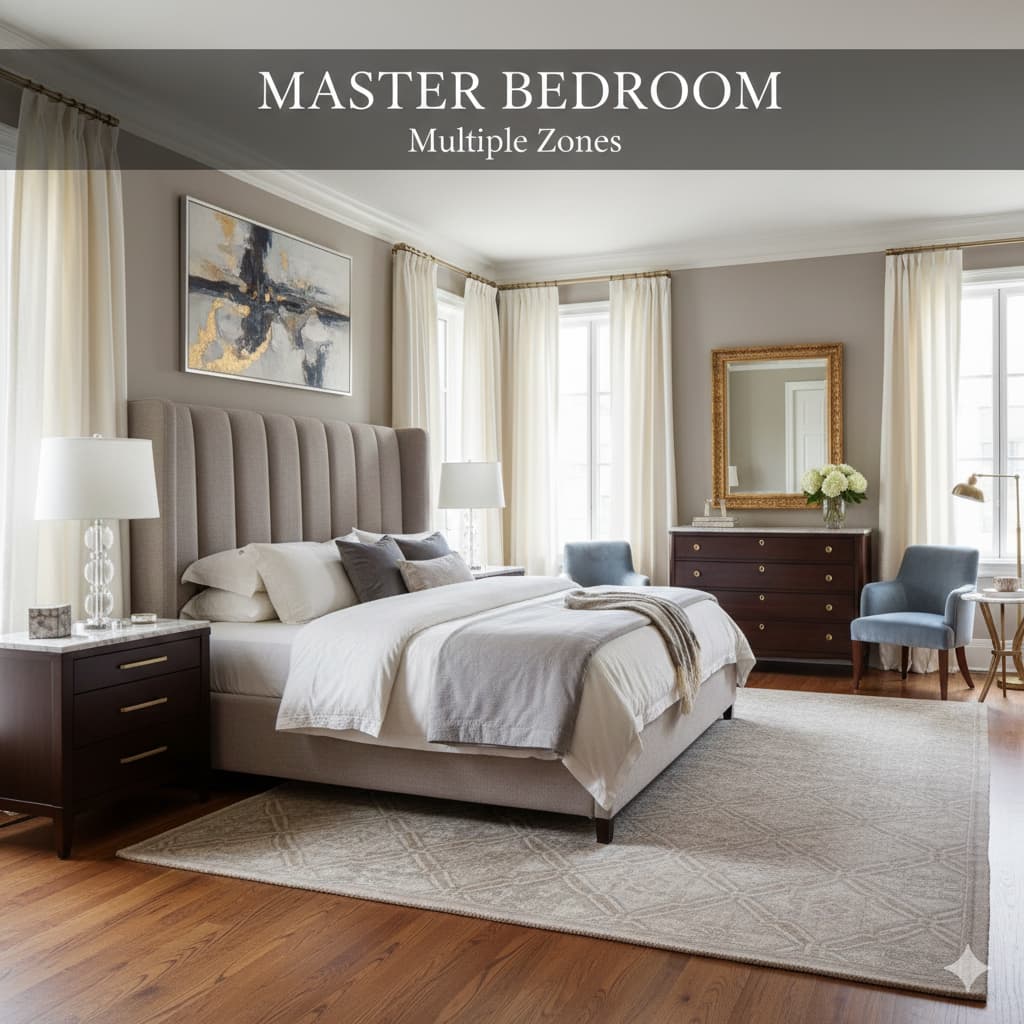
Master bedroom design goes beyond “bigger bedroom with more furniture.” It’s about creating a private retreat that serves multiple functions beyond just sleeping.
Most people approach master bedroom design like: “Cool, we have more space, let’s fill it with stuff!” That’s how you end up with a room that looks furnished but doesn’t actually feel special or restful.
Here’s the mindset shift: Your master bedroom should feel like a luxury hotel suite. Not because you’re trying to impress anyone (nobody sees it but you), but because that’s the standard of comfort and thoughtfulness you deserve.
DEFINING SEPARATE ZONES:
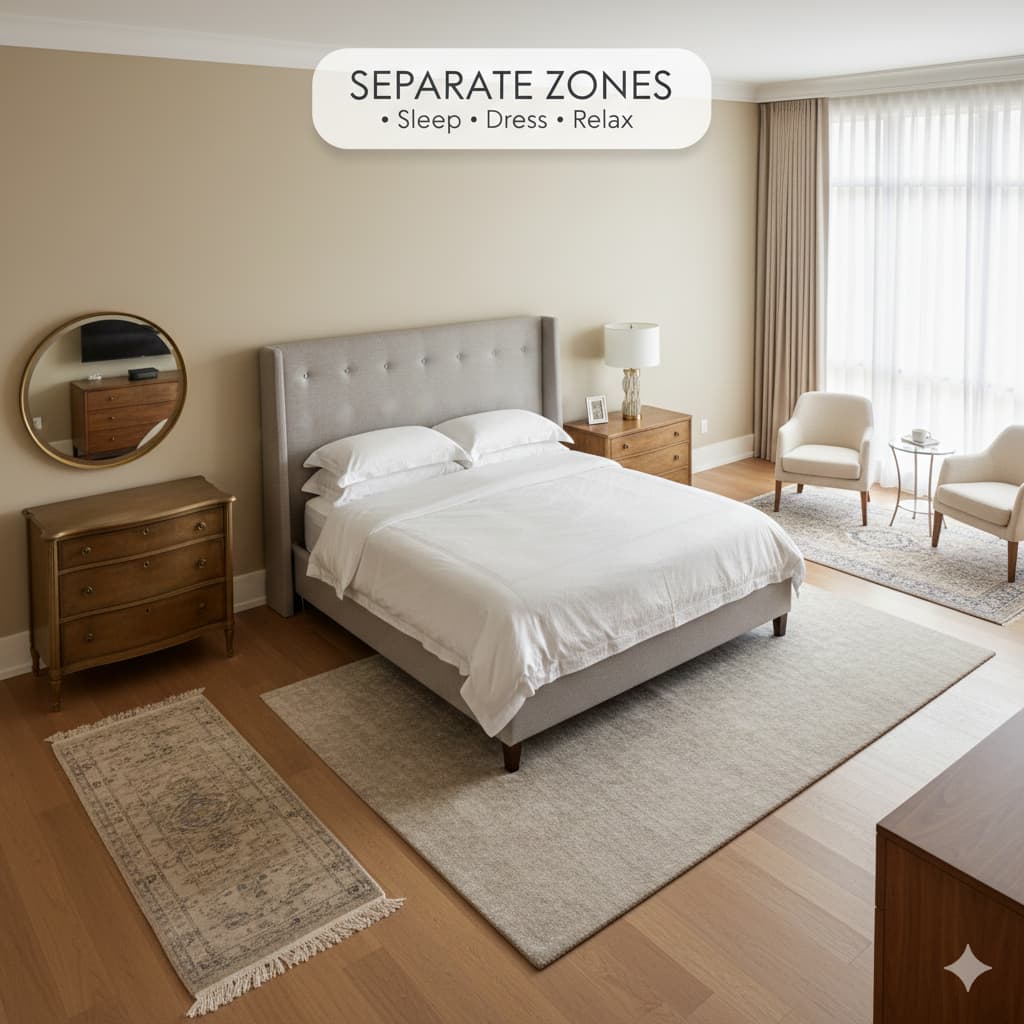
In rooms 14×16 feet and larger, you can create distinct functional areas instead of just “bed plus storage.”
Sleeping zone:
The bed and nightstands, obviously. But also intentional lighting (bedside lamps you can control without getting up), proper blackout window treatments, and nothing that creates work-related stress (no visible desk, no exercise equipment within direct view from bed).
Dressing zone:
This is where your dresser, full-length mirror, and possibly a vanity or dressing table live. Ideally positioned near your closet with good natural or artificial lighting for outfit selection.
Seating area:
Two chairs facing each other or angled toward each other with a small side table between them. This creates a spot for morning coffee, reading, or conversation that doesn’t involve sitting on your bed. Position this near a window if possible for natural light.
MASTER BEDROOM FURNITURE SELECTION:
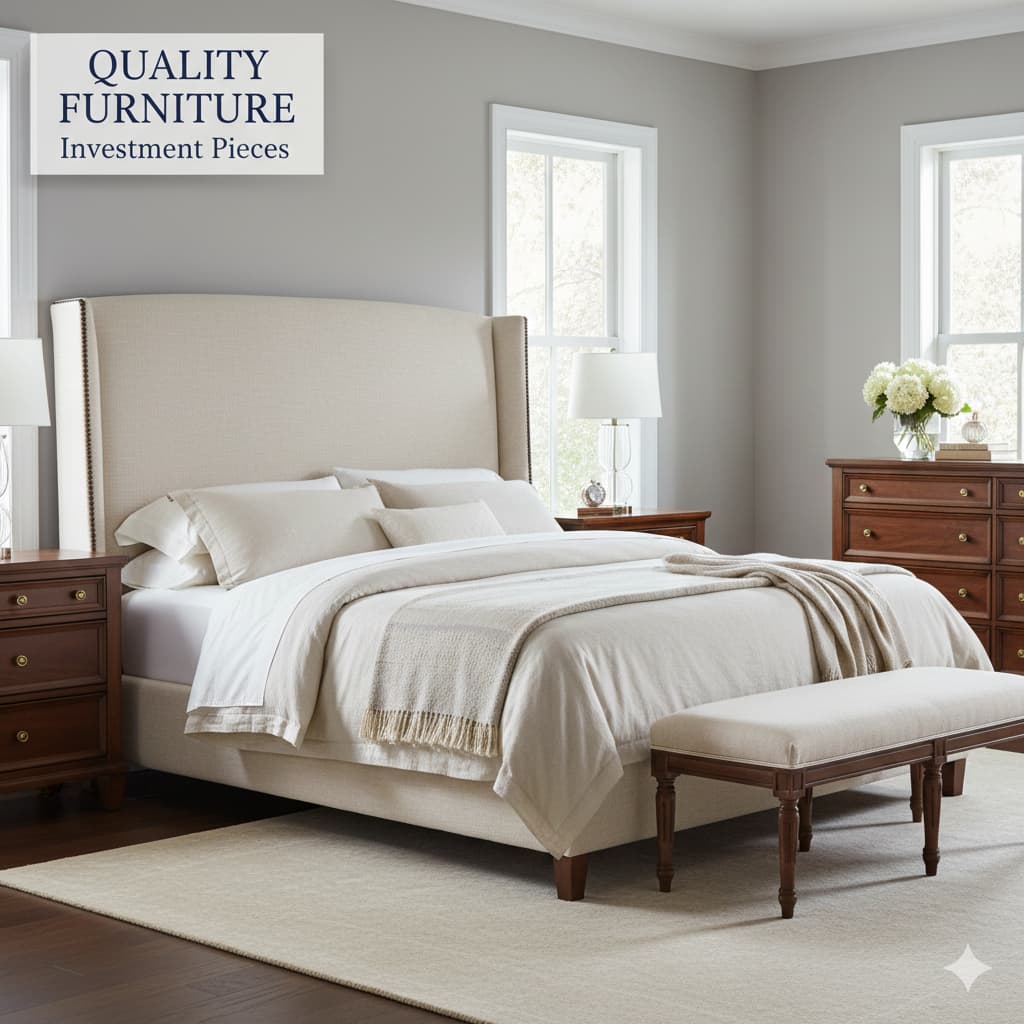
Upgraded bed frame:
Skip the basic platform bed. In a master bedroom, your bed should feel substantial and intentional. Upholstered headboards, quality wood frames, or statement metal frames all work – choose based on your overall style.
Matching nightstand set:
Symmetry matters more in master bedrooms than in small bedrooms. Two matching nightstands create visual balance and equal functionality for both sleepers.
Quality dresser or chest:
In master bedrooms with walk-in closets, you might skip the dresser entirely. But if you’re keeping one, choose quality over size. A beautifully crafted 6-drawer dresser beats a cheap 10-drawer piece every time.
Bench or ottoman at foot of bed:
Not essential in small bedrooms, but it makes sense in a master suite. Provides seating while putting on shoes, holds decorative throw blankets, and fills the visual gap at the foot of a king bed.
MASTER BEDROOM LIGHTING LAYERING:
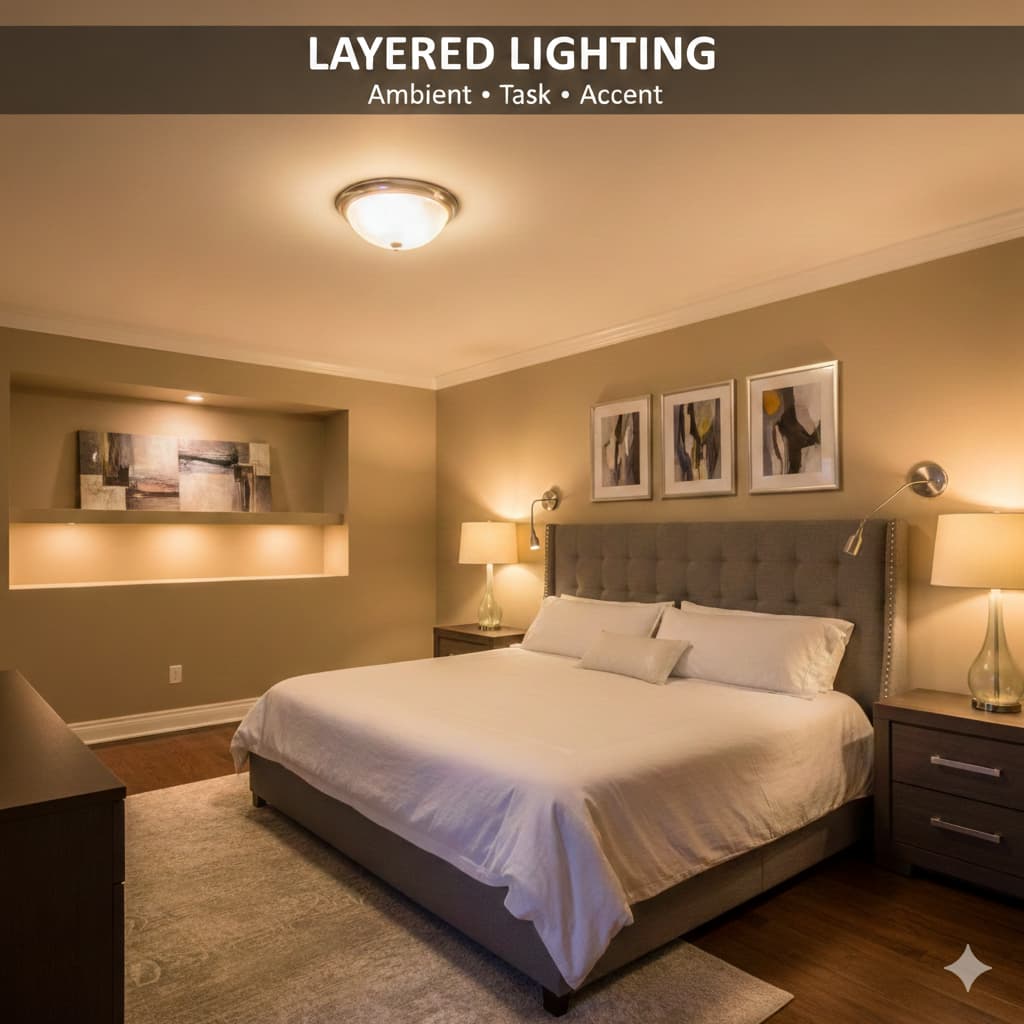
Table lamps on nightstands:
Individually controlled reading lights. Choose lamps with 3-way switches so each person controls their own lighting without affecting the other.
Overhead ambient lighting:
A ceiling fixture or fan with integrated lighting provides general illumination. Install on a dimmer switch so you can adjust based on time of day and mood.
Accent lighting:
Wall sconces, picture lights on artwork, or LED strips under floating shelves create depth and visual interest after dark. This is subtle mood lighting, not functional task lighting.
Task lighting at dresser or vanity:
If you’re getting ready in your bedroom rather than bathroom, you need good lighting at your dressing area. Natural light is ideal (position dresser near window), but add supplemental lighting if needed.
MASTER BEDROOM COLOR SCHEMES:
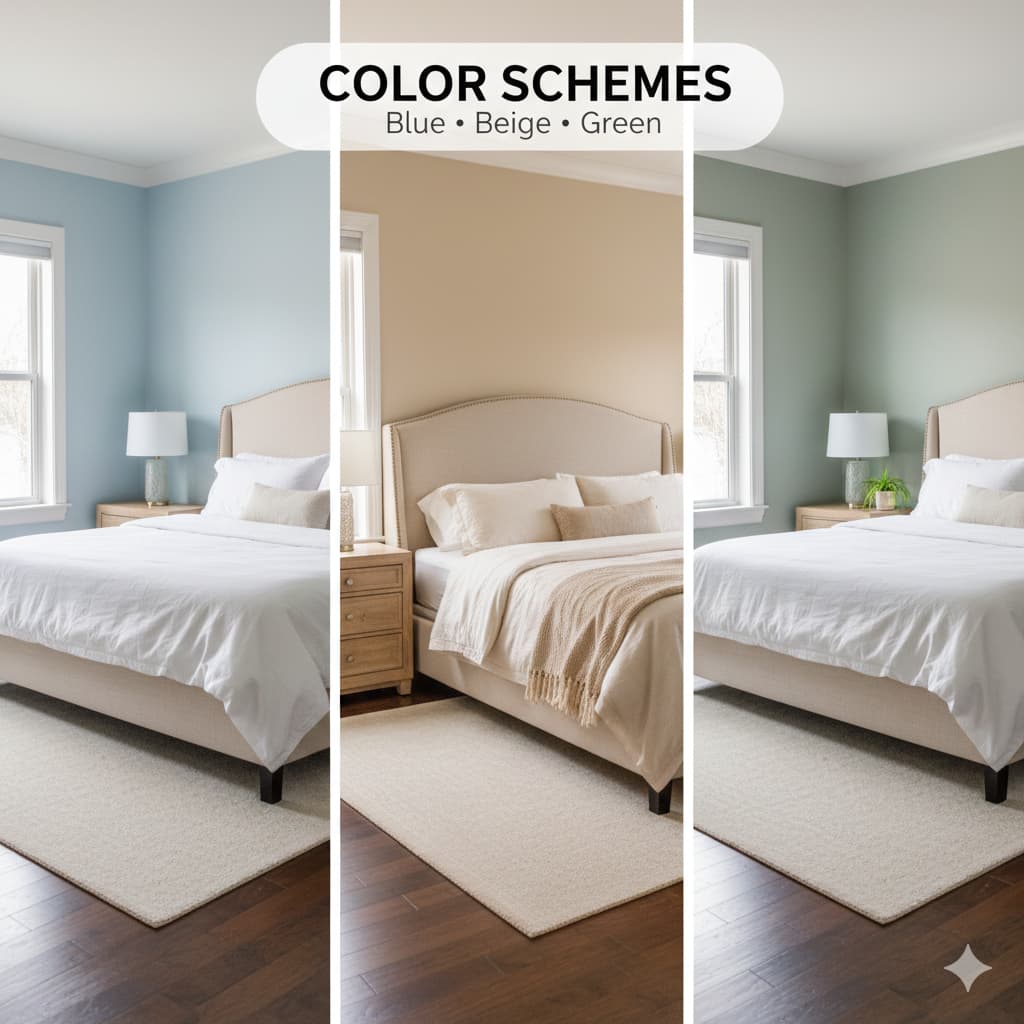
Neutral base with accent colors:
Walls in soft gray, warm beige, or off-white create a calming backdrop. Add personality through bedding, artwork, and accent furniture in bolder colors.
Monochromatic sophisticated:
Various shades of the same color (all grays, all blues, all greens) creates a cohesive, luxurious feel. This approach works especially well in master bedrooms because it feels intentionally designed rather than randomly decorated.
Warm earth tones:
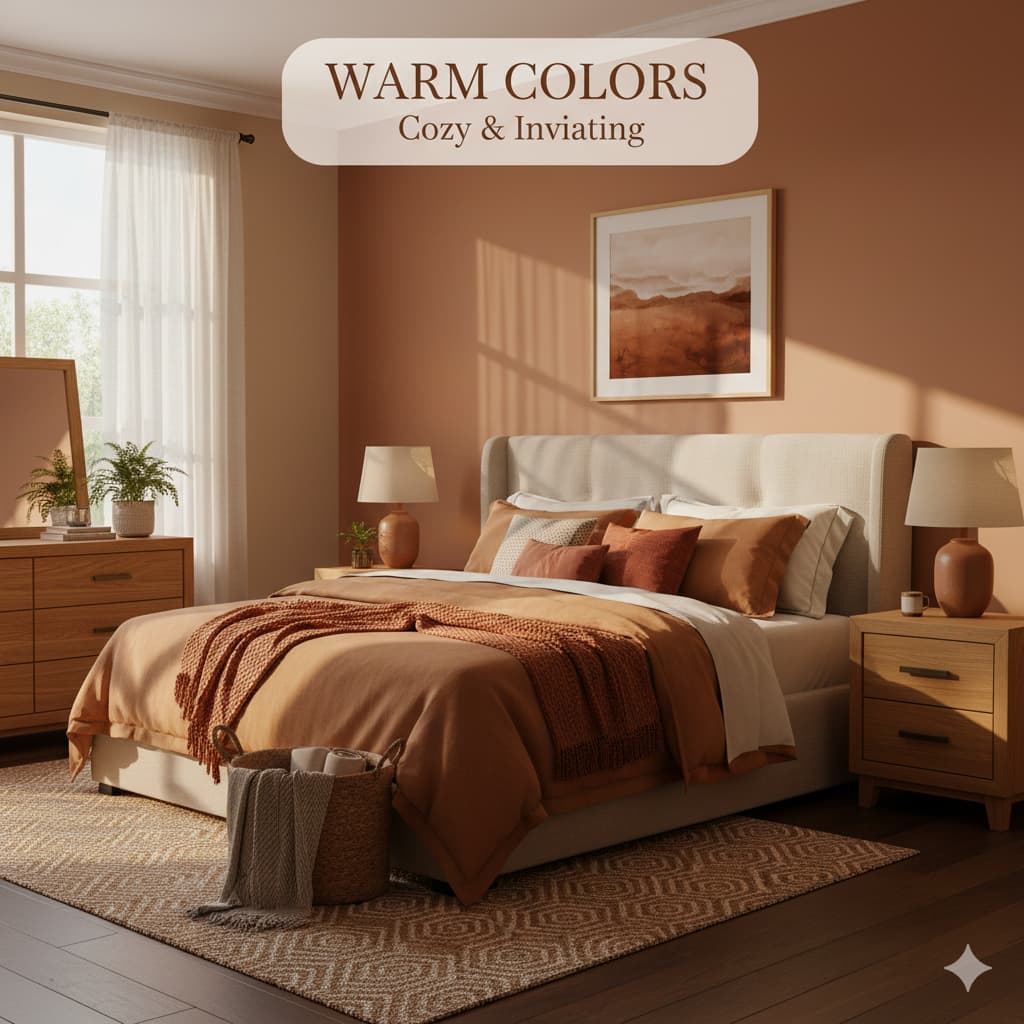
Browns, tans, terracotta, sage green – these create a cozy, organic feeling that’s perfect for bedrooms. Pair with natural materials like wood, linen, and jute.
MASTER BEDROOM STYLE CONSIDERATIONS:
Modern master bedroom:
Clean lines, minimal ornament, emphasis on quality materials and craftsmanship. Platform beds, floating nightstands, geometric lighting. Color palette tends toward neutrals with occasional bold accent colors.
Traditional master bedroom:
Classic furniture silhouettes, detailed woodwork, fabric headboards, coordinated bedroom sets. Warmer color palettes with layered textiles including duvet covers, decorative pillows, and throws.
Transitional master bedroom:
Blend of traditional warmth with modern simplicity. Upholstered bed with simple lines, mix of wood and metal accents, comfortable but uncluttered. This is the most versatile style that ages well.
ENSUITE BATHROOM COORDINATION:
If your master bedroom includes an attached bathroom, design continuity matters. Your bedroom color palette should complement (not necessarily match exactly) your bathroom finishes.
Open concept connection: Some master suites feature open bathroom layouts where the soaking tub is visible from the bedroom. This works in luxury spaces but requires cohesive design thinking from the start.
Privacy considerations: Even with an ensuite, maintain some visual separation. Pocket doors, barn doors, or French doors preserve openness while allowing privacy when needed.
Master bedroom design establishes sophisticated spatial organization supporting intended activities while maintaining clear circulation paths and visual balance. Furniture arrangement follows proven principles including conversation distance optimization, traffic flow preservation, and focal point establishment through considered layout development.
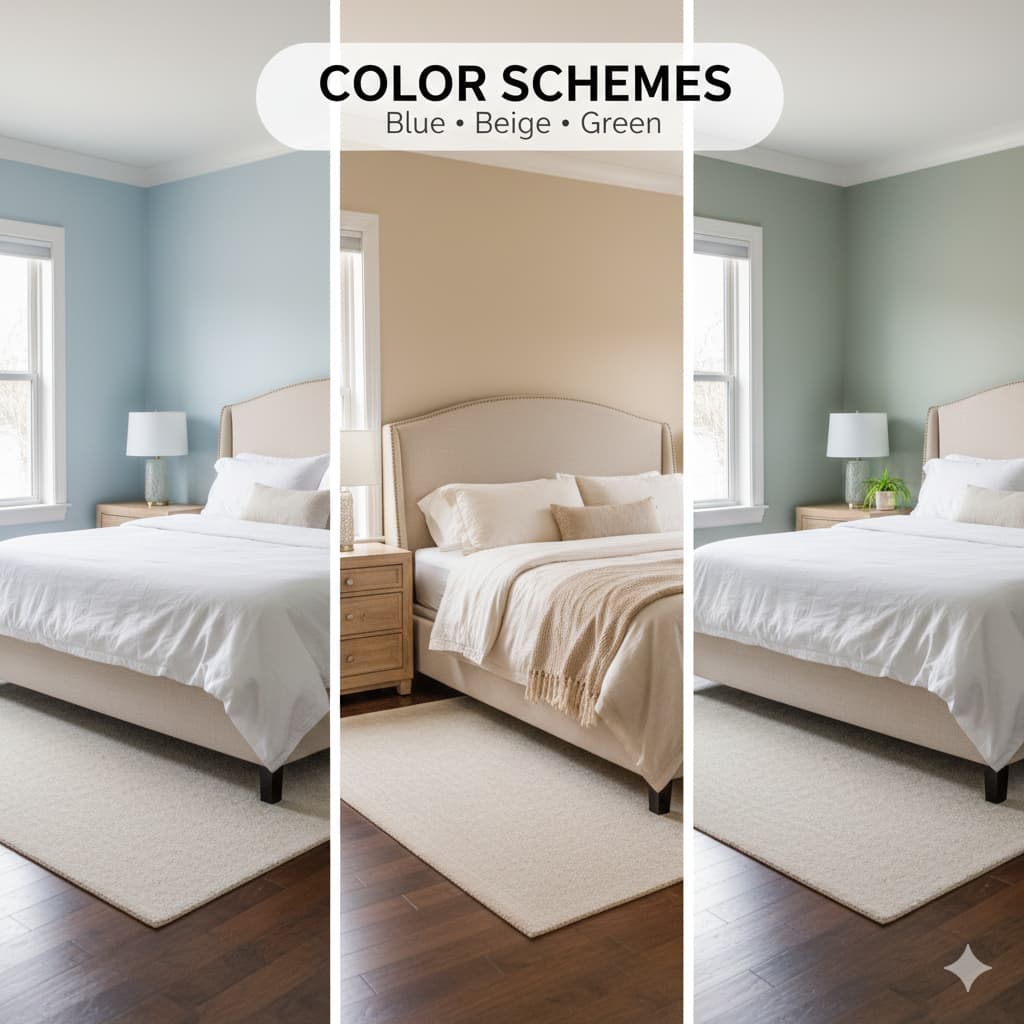
Let’s talk about something most bedroom design articles get completely wrong: color.
The typical advice is “blue is calming, use blue in bedrooms.” Okay, sure. But which blue? Navy? Sky blue? Teal? And what if you hate blue? Are you just out of luck?
Here’s the actual truth about bedroom colors: The “right” color is the one that makes you feel good when you’re in the space. Yes, there are general psychological principles about color, but your personal response matters more than generic rules.
That said, understanding color psychology helps you make informed choices instead of just guessing.
WARM COLORS IN BEDROOMS:
Soft whites and off-whites:
Not technically warm, but feels warmer than stark white. Creates a blank canvas that lets your bedding and furniture become the focal points. Works with literally any design style. The most versatile bedroom wall color.
Beiges and tans:
Genuinely warm neutrals that create coziness without feeling dark or heavy. Especially good in bedrooms with limited natural light because they reflect light while adding warmth.
Warm grays (greiges):
Gray with beige undertones. More contemporary than pure beige, warmer than cool gray. This has been the go-to bedroom color for the past several years for good reason – it’s sophisticated but not cold.
Soft blush or dusty rose:
Creates a romantic, serene atmosphere without being aggressively pink. Works particularly well in master bedrooms or guest rooms. Pair with white trim and neutral furniture.
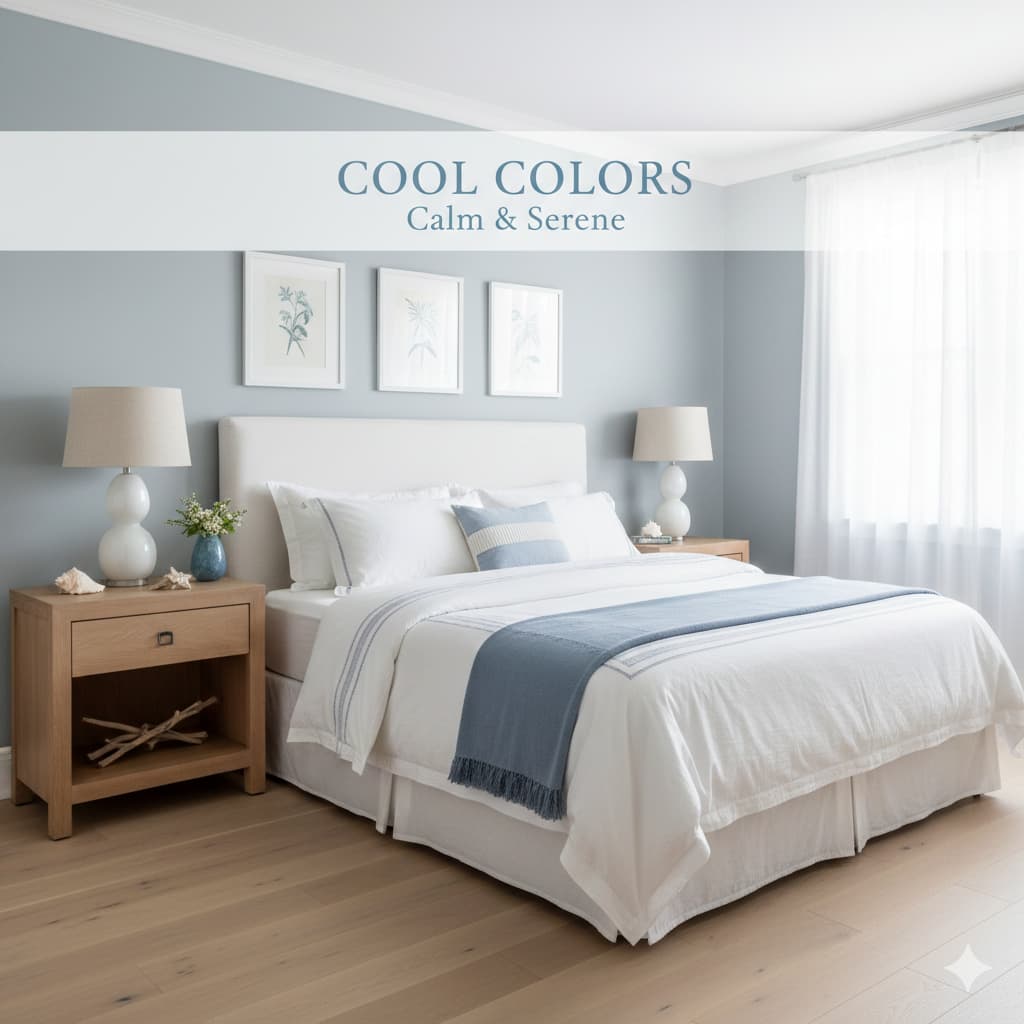
COOL COLORS IN BEDROOMS:
Soft blues:
The classic bedroom color for a reason. Light blue promotes relaxation and feels spacious. Works in any size bedroom. Pair with white bedding and natural wood furniture for a coastal vibe, or with gray and black accents for a more masculine feel.
Sage green:
Having a moment right now, and for good reason. It’s calming like blue but feels fresher and more current. Works beautifully with natural materials – wood, linen, jute, plants.
Soft lavender:
More sophisticated than bright purple, less common than blue or green. Creates a serene, slightly feminine atmosphere. Best in rooms with good natural light, as it can feel dull in dark spaces.
Cool grays:
Modern and clean but can feel cold if you go too dark or don’t balance with warm textiles and wood tones. Use in bedrooms with south-facing windows where you get warm natural light.
BOLD COLOR STRATEGIES:
If you’re drawn to bold colors but nervous about commitment, try these approaches:
Accent wall behind bed: Dark navy, forest green, charcoal, or even black on the bed wall creates drama without overwhelming the space. Keep the other three walls neutral.
Colorful ceiling: Unexpected and interesting. A soft blue or warm terracotta ceiling feels enveloping but not claustrophobic because walls remain neutral.
Colorful bedding and accessories: Keep walls neutral and introduce bold colors through easily changeable elements. You can switch your entire color scheme by changing duvet covers and throw pillows.
COLOR COMBINATIONS THAT WORK:
White walls + gray bedding + natural wood:
Clean, modern, works in any bedroom size. Add warmth with textured throw blankets and plants.
Soft blue walls + white bedding + brass accents:
Classic and calming. The brass or gold metal accents add warmth that keeps the blue from feeling cold.
Sage green walls + cream bedding + black accents:
Current and sophisticated. The black keeps it from feeling too soft or muted.
Warm gray walls + blush bedding + white and wood:
Romantic and cozy without being overly feminine. Works in master bedrooms or guest rooms.
Beige walls + layered neutral textiles + mixed metals:
Timeless and versatile. Layer different textures in similar colors (linen, cotton, velvet, wood) for depth.
WHAT TO AVOID:
Bright red walls: Too energizing for a sleep space. If you love red, use it as an accent color in artwork or throw pillows.
All-dark everything: Black walls can work, but only in large bedrooms with excellent natural light. In small or dark bedrooms, it’s oppressive.
Too many colors: More than 3-4 colors creates visual chaos. Pick a main wall color, a bedding color, an accent color, and stick with those.
Color coordination strategies extend beyond wall paint selection encompassing furniture upholstery, window treatments, flooring tones, and decorative accessories creating comprehensive color relationships. Successful living room design maintains color consistency across elements while introducing sufficient variation preventing monotonous uniformity.
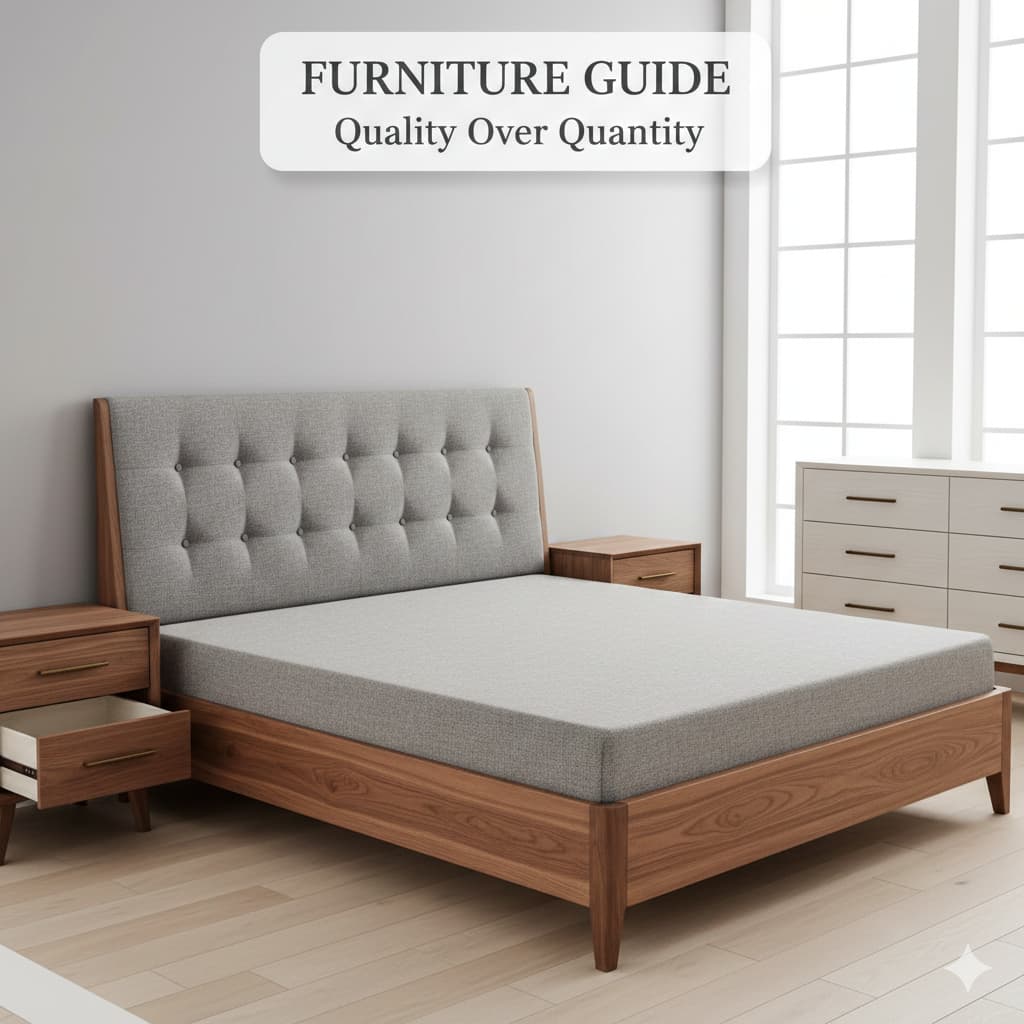
Shopping for bedroom furniture should be straightforward. It’s not.
Walk into any furniture store and you’ll find “bedroom sets” – matching bed, two nightstands, dresser, mirror, and sometimes a chest. They’re convenient. They’re coordinated. And they’re almost never the best choice.
Here’s why: Bedroom sets are designed to fit the largest common bedroom size (around 14×16 feet). If your bedroom is smaller, you’re buying furniture that’s too bulky for your space. If it’s larger, you’re buying furniture that looks undersized. Plus, matching everything creates a showroom look that feels staged rather than personal.
Instead, let’s talk about how to select each piece based on what you actually need.
BED FRAME SELECTION:
Platform beds:
No box spring needed, lower profile, often include built-in storage. Best for modern or minimalist bedrooms. Height typically 12-18 inches including mattress.
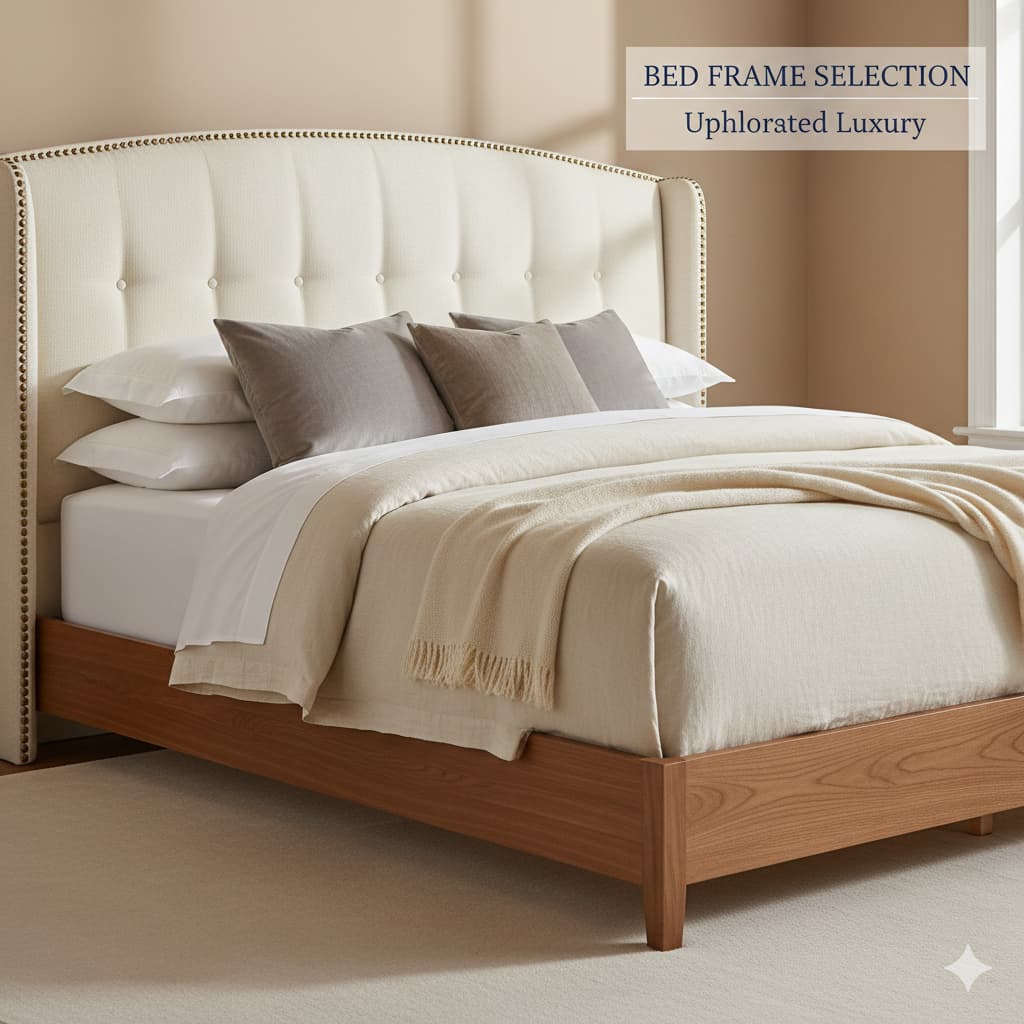
Upholstered beds:
Fabric or leather headboard, usually taller and more substantial-looking. Best for traditional or transitional bedrooms. Comfortable to lean against for reading in bed.
Wood or metal frames:
Classic options that work with any style depending on finish and details. Wood frames feel warmer and more traditional, metal frames feel more modern or industrial.
Storage beds:
Built-in drawers underneath. Great for small bedrooms lacking closet space. Requires 10-12 inches of platform height for meaningful storage depth.
What matters more than style: Construction quality. Your bed frame should be solid – no wobbling, no squeaking, no gaps between frame pieces. Cheap bed frames are a terrible investment because you notice every flaw every single night.
NIGHTSTAND SELECTION:
Size considerations:
Width: 20-28 inches (smaller for tight spaces, larger for spacious bedrooms)
Depth: 16-20 inches (deeper if you need more surface space)
Height: Level with mattress or 2-3 inches below
Storage needs:
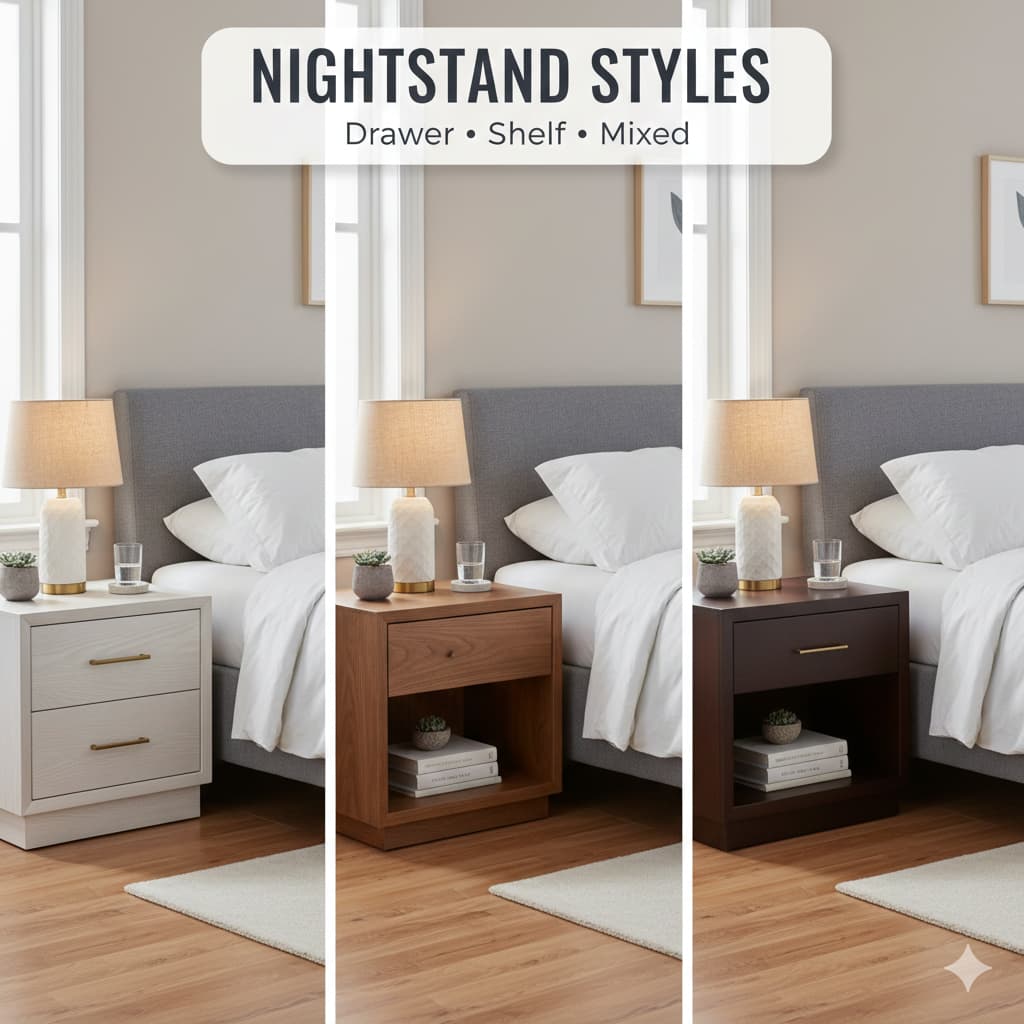
Open shelf style: Good for displaying books or decorative items, but everything is visible (including clutter)
Drawer storage: Better for hiding items like medications, chargers, personal items
Mix of both: One open shelf, one drawer – versatile option
Number of nightstands:
Two matching: Creates symmetry, equal access for both sleepers
One nightstand: Fine for small bedrooms or solo sleepers, position on side you use most
Asymmetrical: Two different nightstands can work in eclectic or bohemian styles
DRESSER SELECTION:
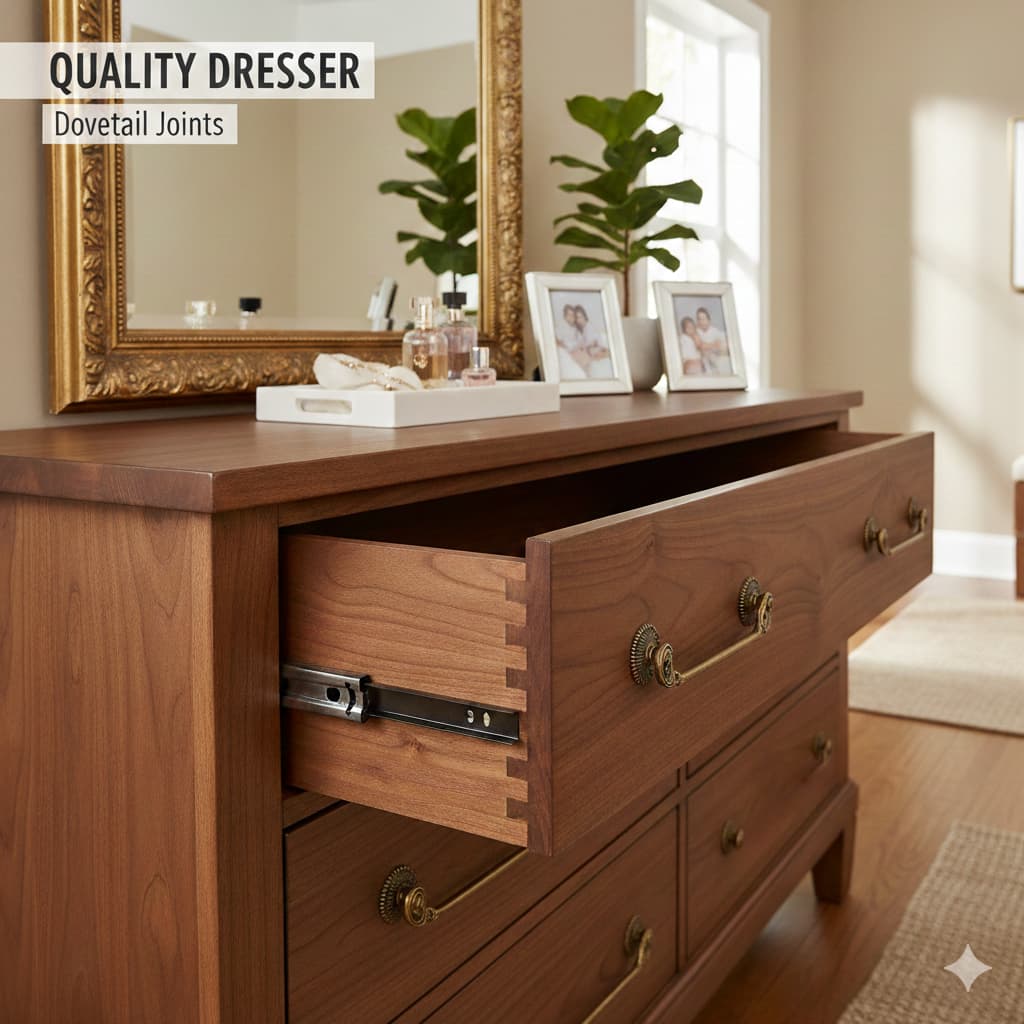
Horizontal dressers:
9-10 drawer style, typically 60-72 inches wide
Best for: Rooms where you have a long wall available, couples sharing storage
Drawbacks: Takes up significant wall length, limits furniture arrangement options
Vertical dressers (chests):
5-6 drawer tall style, typically 30-40 inches wide
Best for: Smaller bedrooms, rooms where you need wall length for other furniture
Benefits: Uses vertical space efficiently, leaves more floor space
Dresser alternatives:
Built-in closet systems: If you have a walk-in closet, you might not need a bedroom dresser at all
Armoires: Tall enclosed storage, works well in bedrooms with architectural character
Modular storage: Mix of small pieces that can be reconfigured
Quality markers to look for:
Drawers with dovetail joints (not just glued or stapled together)
Smooth drawer glides that fully extend
Solid wood or quality plywood construction (not particle board)
Felt-lined top drawers for delicate items
ADDITIONAL FURNITURE (OPTIONAL):
Bedroom bench:
Position at foot of bed or under window. Useful for seating while putting on shoes, storage underneath for extra blankets, or purely decorative.
Size guide: 60-75% of bed width, 16-20 inches deep, 18-20 inches tall
Accent chairs:
Creates a reading nook or sitting area separate from the bed. Best in master bedrooms 14×16 feet and larger.
Look for: Comfortable seat depth (21-24 inches), supportive back, easy to get in and out of
Bedroom desk or vanity:
If working from home or need a getting-ready station. Requires at least 48 inches of wall space.
Desk: 48-60 inches wide, 24-30 inches deep
Vanity: 36-48 inches wide, 18-20 inches deep
MIXING FURNITURE STYLES:
You don’t need everything to match. In fact, thoughtfully mixed furniture looks more personal and interesting than coordinated sets.
What should coordinate:
– Finish tones (all warm woods, or all cool woods, not mixed)
– Scale (all pieces should feel appropriately sized for the room)
– Design era (don’t mix ultra-modern with heavily traditional)
What doesn’t need to match:
– Exact wood color
– Hardware style
– Specific furniture style details
Example of good mixing: Modern platform bed in walnut + mid-century modern nightstands in teak + contemporary dresser in warm wood
Example of bad mixing: Ornate Victorian bed + ultra-minimalist floating nightstands + rustic farmhouse dresser
BEDROOM FURNITURE INVESTMENT PRIORITIES:
Splurge on:
Bed frame (you interact with it every day, quality matters)
Mattress (obviously – affects sleep quality directly)
Dresser (should last 10-15+ years if quality is good)
Save on:
Nightstands (simpler construction, easier to replace, less impact if lower quality)
Decorative furniture like benches or accent chairs (pure aesthetics, not daily-use functional)
Mirrors and accessories (personal taste changes, good to keep flexible)
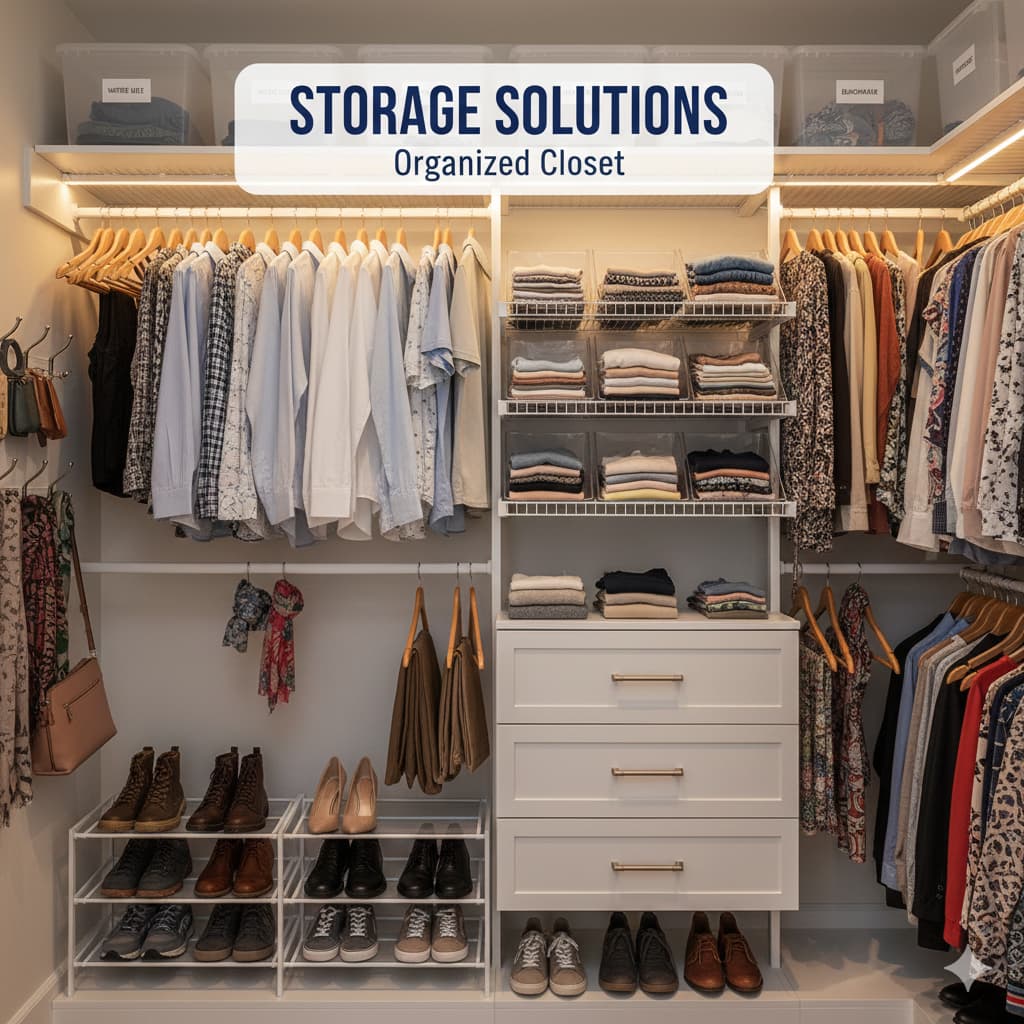
Storage is where bedroom design usually falls apart.
You’ve got the pretty bed, the matching nightstands, maybe even that Instagram-worthy accent chair. But your clothes are piled on that chair. Your dresser drawers don’t close because they’re overstuffed. Random items live on your nightstand because you have nowhere else to put them.
Sound familiar?
Storage isn’t a “nice to have” – it’s the foundation of a functional bedroom. Without adequate, well-organized storage, even the most beautifully designed bedroom becomes cluttered chaos.
CLOSET ORGANIZATION SYSTEMS:
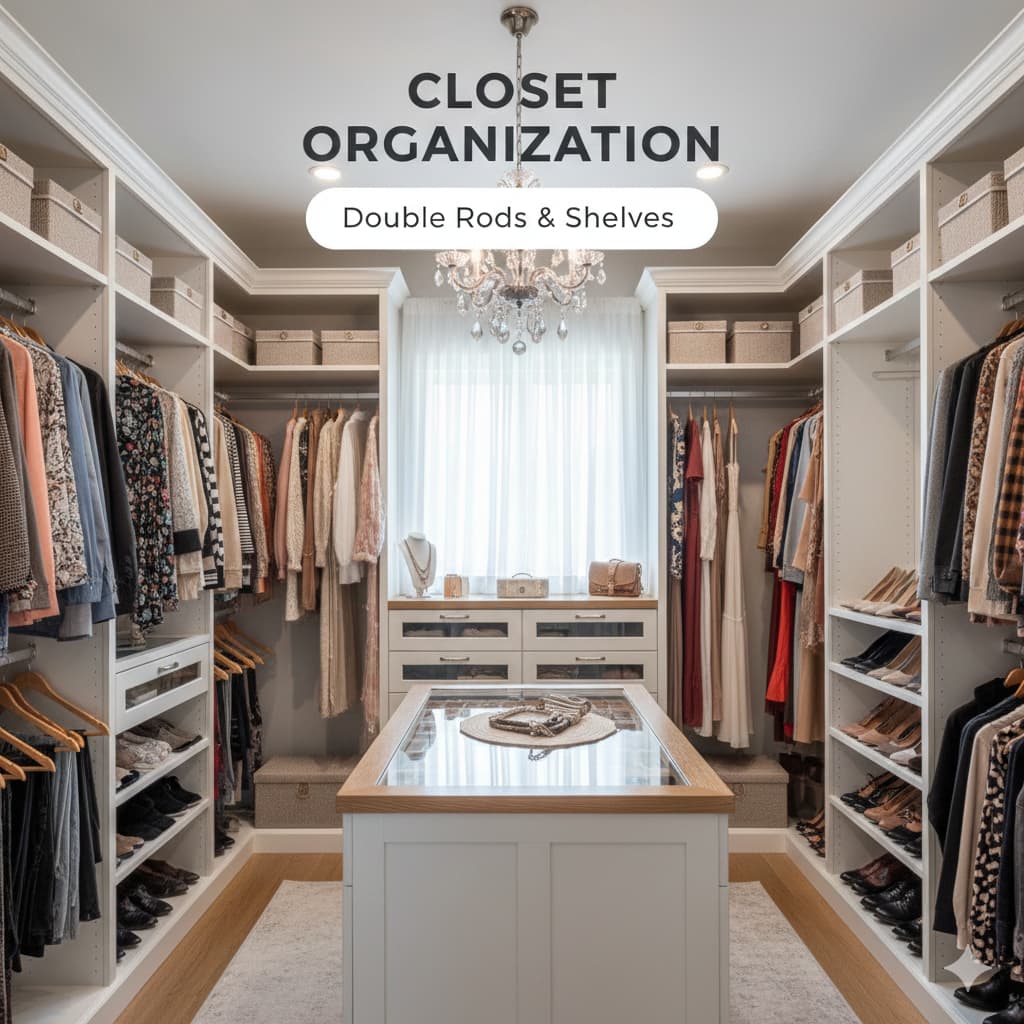
If you have a reach-in closet:
Standard closet rods waste vertical space. Add a second rod below the top one for shirts and pants. This doubles your hanging capacity instantly.
Add shelf dividers to keep folded stacks separated and prevent the avalanche effect when you pull out one item.
Use the closet door: Over-door hooks or hanging organizers for accessories, bags, or frequently worn items.
If you have a walk-in closet:
Invest in a closet system. Whether custom or from a company like IKEA or Container Store, a properly designed system transforms storage capacity.
Hanging space for long items (dresses, coats): One section with full-height rod
Hanging space for tops and pants: Double rods at two heights
Shelf storage: Adjustable shelves for folded items and bins
Drawer units: For items that work better folded (sweaters, t-shirts, workout clothes)
DRESSER ORGANIZATION:
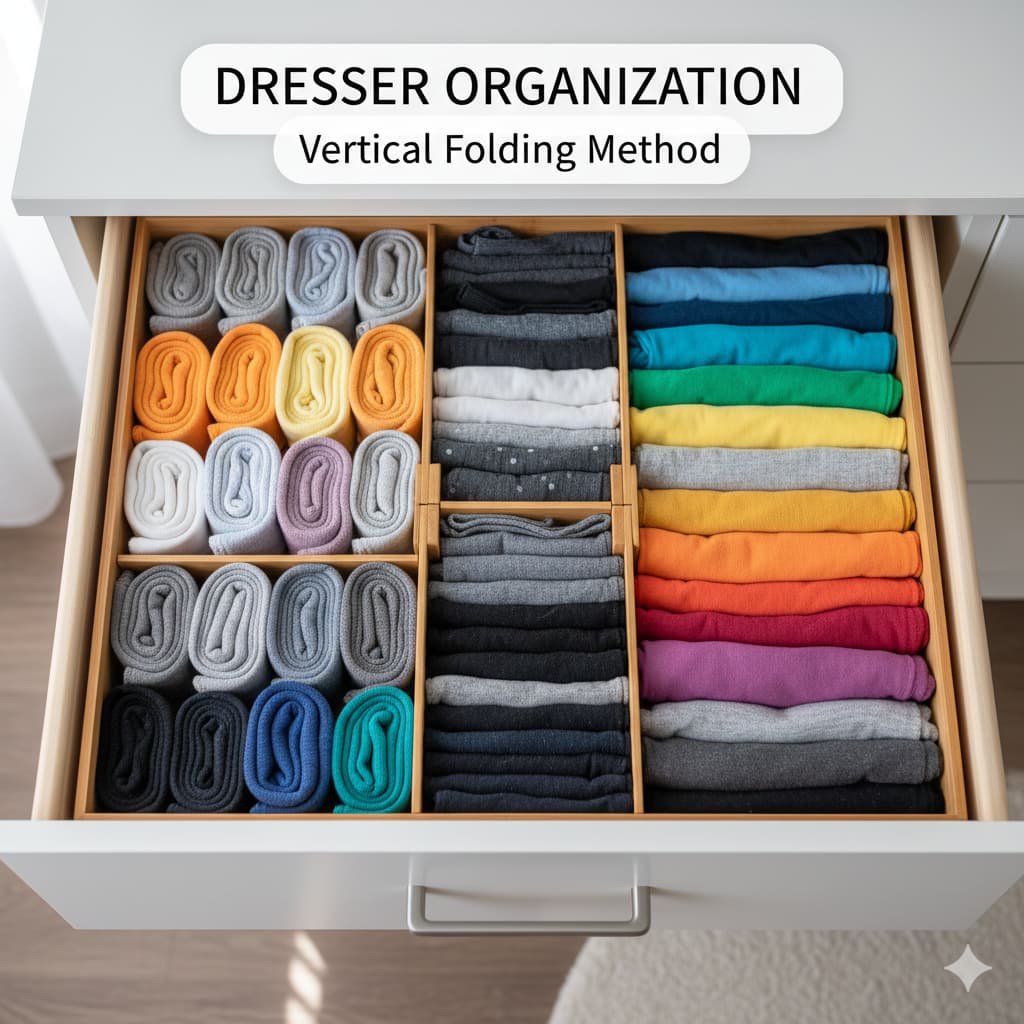
Drawer dividers: Separate socks, underwear, accessories within drawers so items don’t become a jumbled mess.
Fold clothes properly: Marie Kondo-style vertical folding makes items visible and accessible. You can see everything at once instead of digging through stacks.
Top drawer: Small items like jewelry, watches, sunglasses – add a jewelry tray or small organizers
Middle drawers: Folded clothes, organized by type
Bottom drawers: Bulkier items like sweaters, sweatshirts, or workout clothes
UNDER-BED STORAGE:
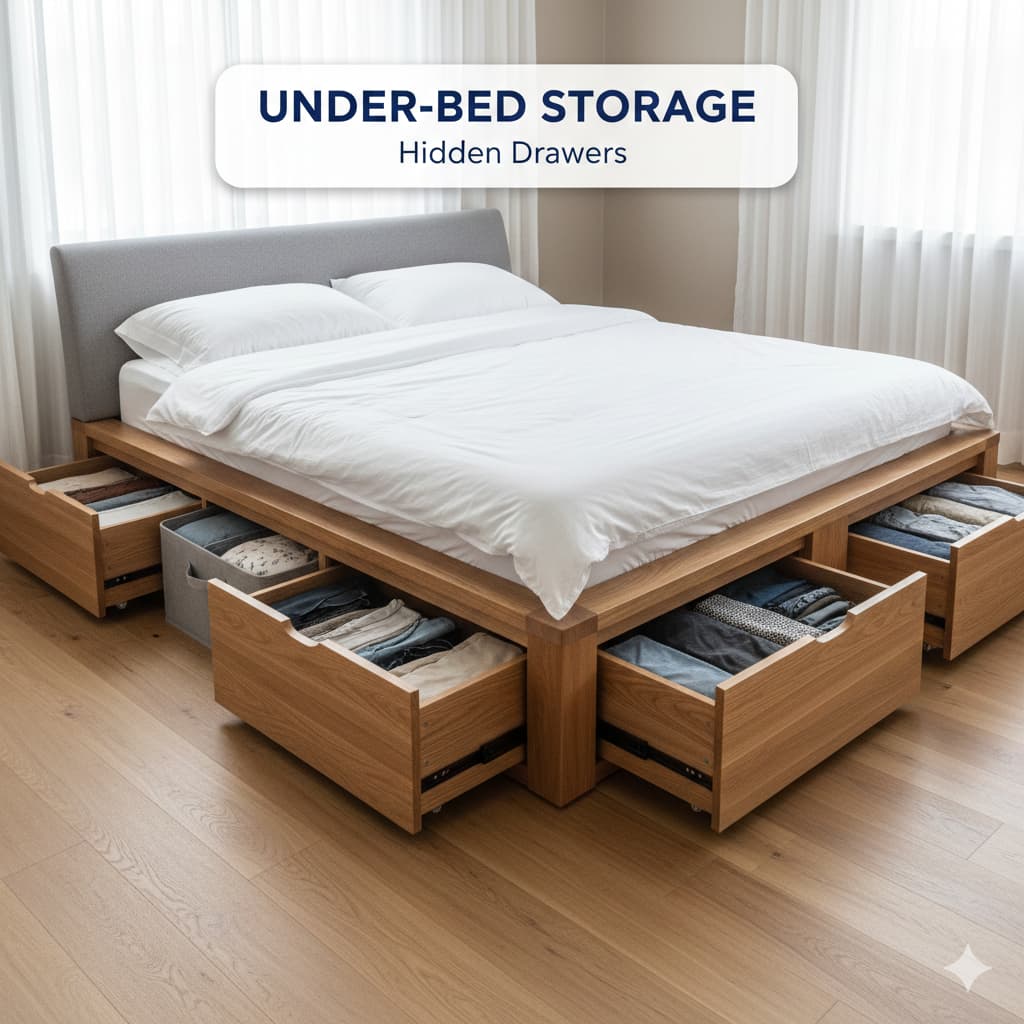
Storage bed with built-in drawers: The most elegant solution if you’re buying a new bed. Provides significant storage without looking like storage.
Rolling under-bed bins: Work with existing beds. Choose low-profile bins that fit your bed height. Measure carefully – many beds have center support bars that block full-width containers.
What to store under bed: Off-season clothes, extra bedding, shoes, items you need but don’t access frequently
What NOT to store under bed: Anything that attracts dust or needs to breathe (leather items, certain fabrics)
VERTICAL STORAGE SOLUTIONS:
Wall-mounted shelves above nightstands: Keeps surfaces clear while providing display and storage space.
Tall narrow bookcases: In corners or beside windows, these use vertical space without consuming much floor space.
Over-door organizers: Hanging shoe organizers work for way more than shoes – accessories, small electronics, craft supplies.
MULTI-FUNCTIONAL FURNITURE:
Ottoman with storage: At foot of bed or in seating area, provides hidden storage plus seating or footrest function.
Nightstands with drawers: Instead of open shelves, enclosed storage keeps necessary items accessible but hidden.
Bench with storage: Useful at foot of bed for putting on shoes while storing extra blankets or seasonal items underneath.
SMALL BEDROOM STORAGE STRATEGIES:
When space is limited, every piece must work harder:
Platform bed with drawers: Eliminates need for separate dresser in very small rooms
Wall-mounted nightstands: Floating shelves with small drawer units mounted below, saves floor space
Vertical dresser instead of horizontal: Uses less wall length, works in narrow rooms
Closet system maximization: If closet storage is well-organized, you might not need bedroom furniture storage at all
STORAGE MISTAKES TO AVOID:
Overstuffing dresser drawers: If drawers don’t close easily or items get wrinkled, you have too much in them
Visible clutter storage: Open bins or baskets full of random items don’t look organized, they look messy
Storing everything in bedroom: Your bedroom isn’t a catch-all storage room. Move items used in other rooms out of the bedroom entirely
Underutilizing closet vertical space: The space above your closet rod is prime storage real estate
The key principle: Everything you keep in your bedroom should have a designated home. If it doesn’t fit in your existing storage, you either need more storage or fewer items. There’s no third option.
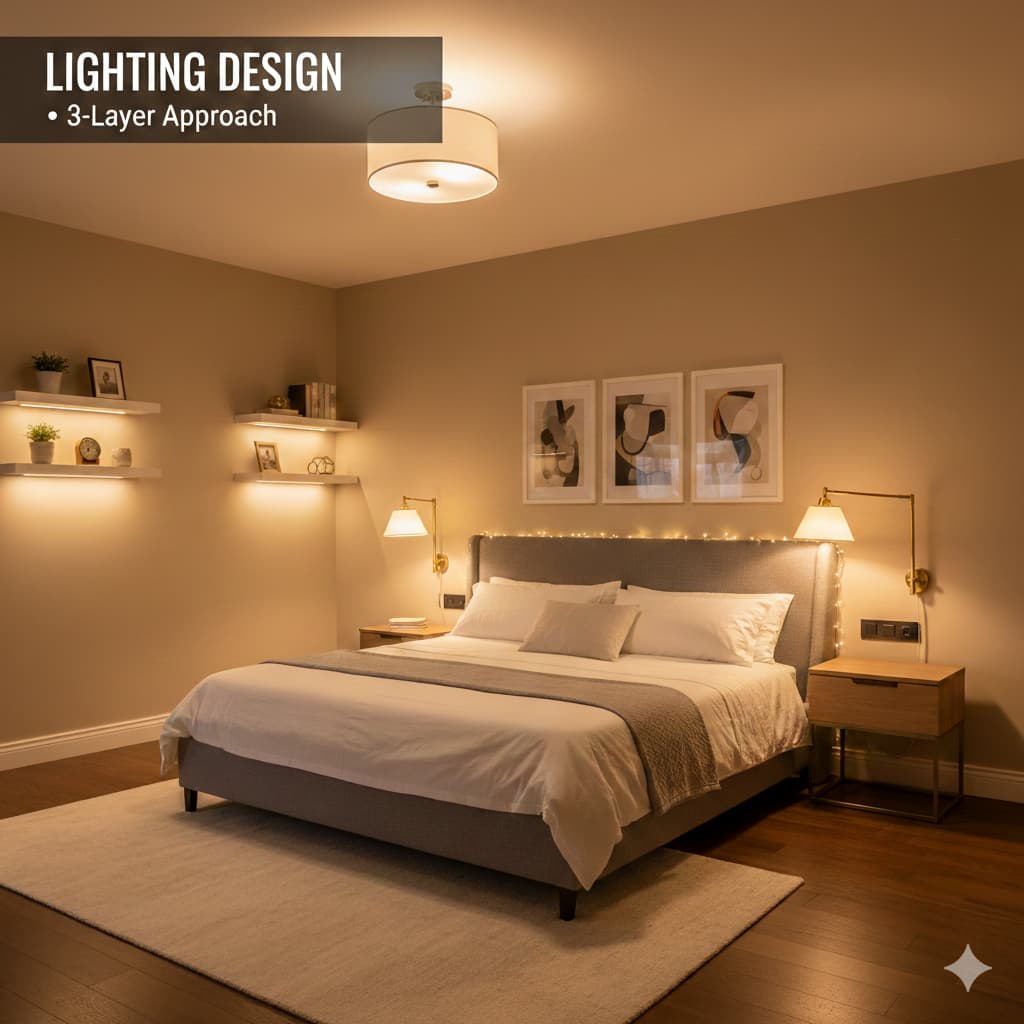
Lighting can make or break your bedroom design. I’m not exaggerating.
You can have the perfect furniture layout, beautiful color scheme, and thoughtfully chosen decor – but bad lighting will ruin all of it. The room will feel harsh when you want to relax, too dark when you’re getting dressed, and frustrating when you’re trying to read.
Most bedrooms have one overhead light on a single switch. That’s it. That’s terrible lighting design.
Here’s what actually works:
AMBIENT LIGHTING (GENERAL ILLUMINATION):
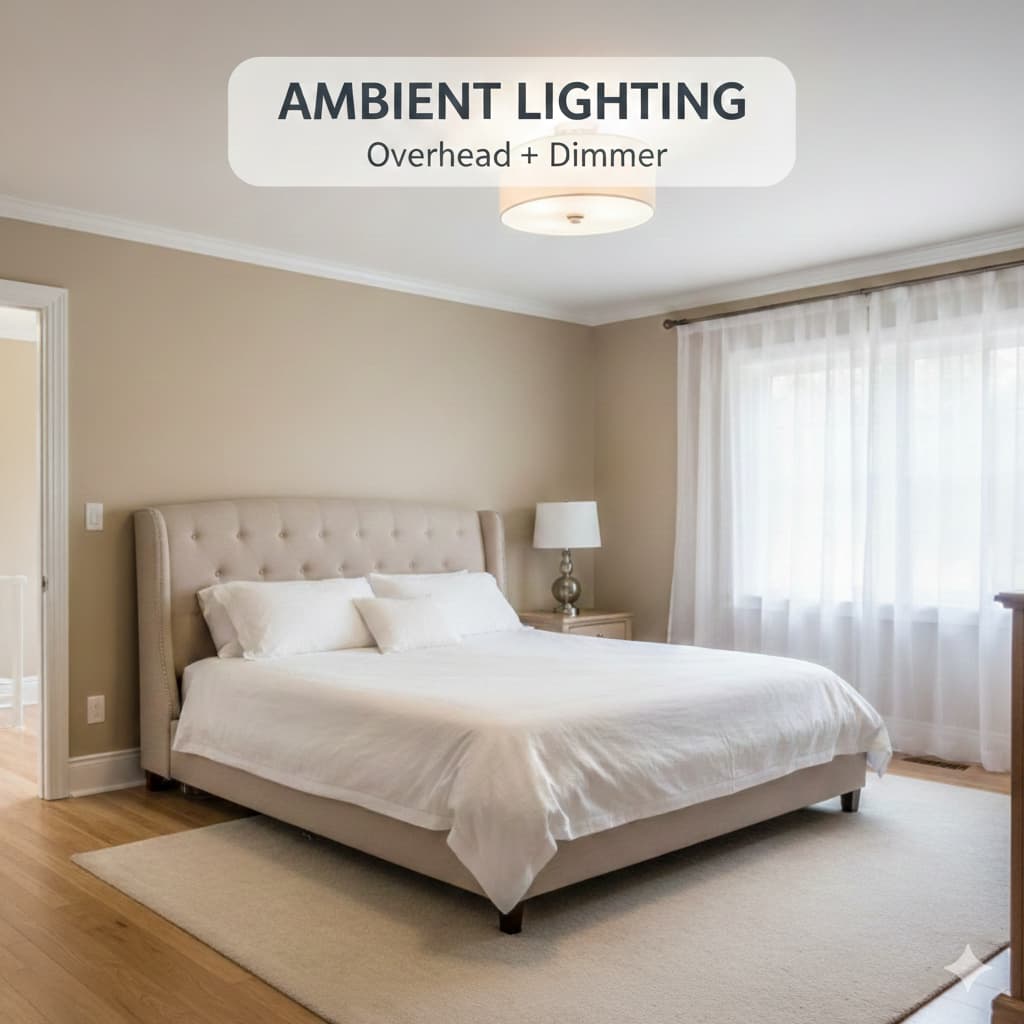
Ceiling fixture or fan with light:
Provides overall room lighting. Should be on a dimmer switch so you can adjust brightness based on time of day and activity.
For bedrooms 12×14 feet or smaller: 60-75 watt equivalent LED
For bedrooms 14×16 feet or larger: 75-100 watt equivalent LED
Recessed lighting:
More modern aesthetic than a hanging fixture. Space fixtures 4-6 feet apart for even coverage. Also requires dimmer switch.
What to avoid: Single bright overhead light on full blast – this is harsh and uninviting in a bedroom
TASK LIGHTING (FUNCTIONAL LIGHTING):
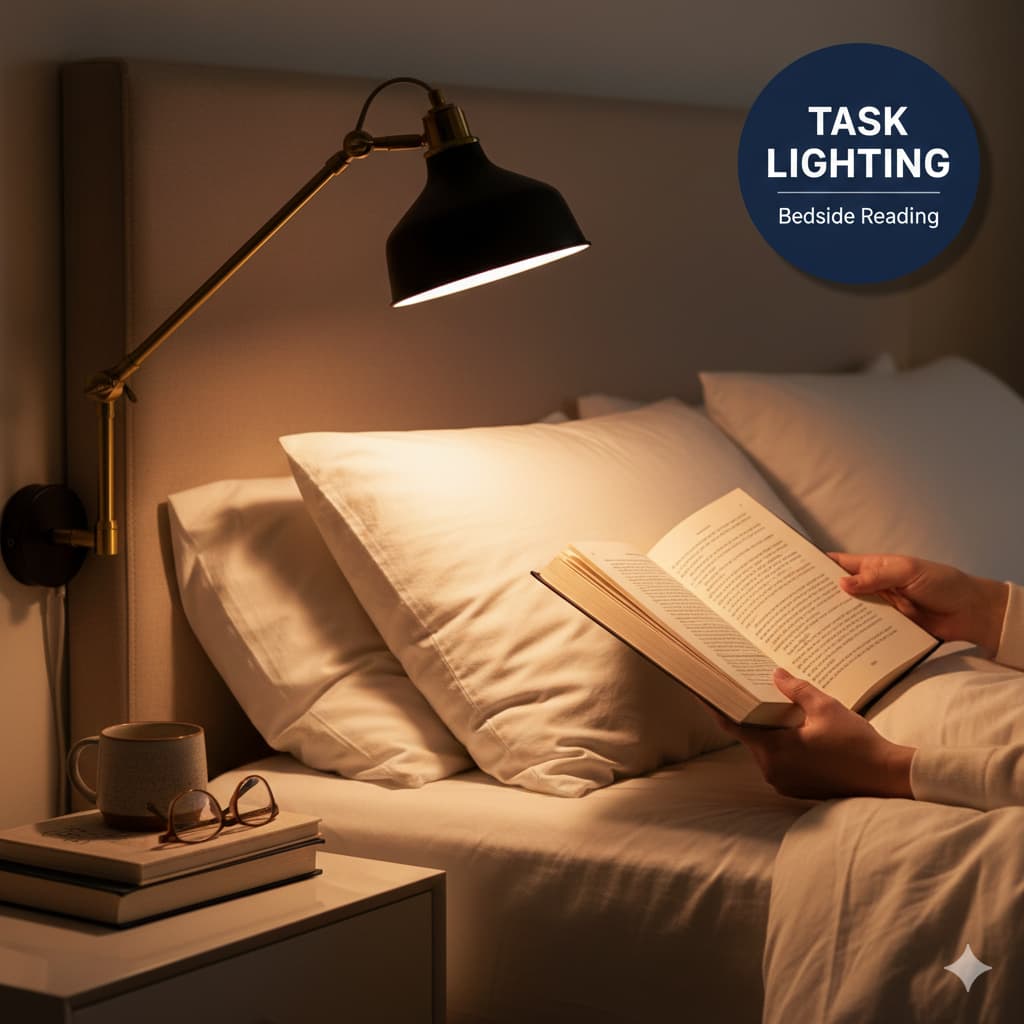
Bedside reading lights:
Essential for anyone who reads in bed. Each person needs independently controlled lighting.
Table lamps on nightstands: Classic solution, choose lamps with 3-way switches (low-medium-high)
Wall-mounted swing-arm lamps: Save nightstand surface space, adjustable for reading position
Pendant lights: Hang from ceiling beside bed, creates a modern look
Light bulb choice: 40-60 watt equivalent LED, warm white (2700-3000K color temperature)
Dresser or vanity lighting:
If you get ready in your bedroom, you need good lighting at your dressing area.
Natural light: Position dresser near window if possible
Lighted mirror: Built-in lighting around mirror edges provides even facial lighting
Table lamp on dresser: If no other lighting options available
Closet lighting:
Cannot emphasize this enough – you need good lighting in your closet to see clothing colors accurately.
Motion-sensor LED strips: Automatically illuminate when you open closet door
Battery-operated puck lights: Easy to install without electrical work
Overhead closet fixture: Wired option for walk-in closets
ACCENT LIGHTING (MOOD AND ATMOSPHERE):
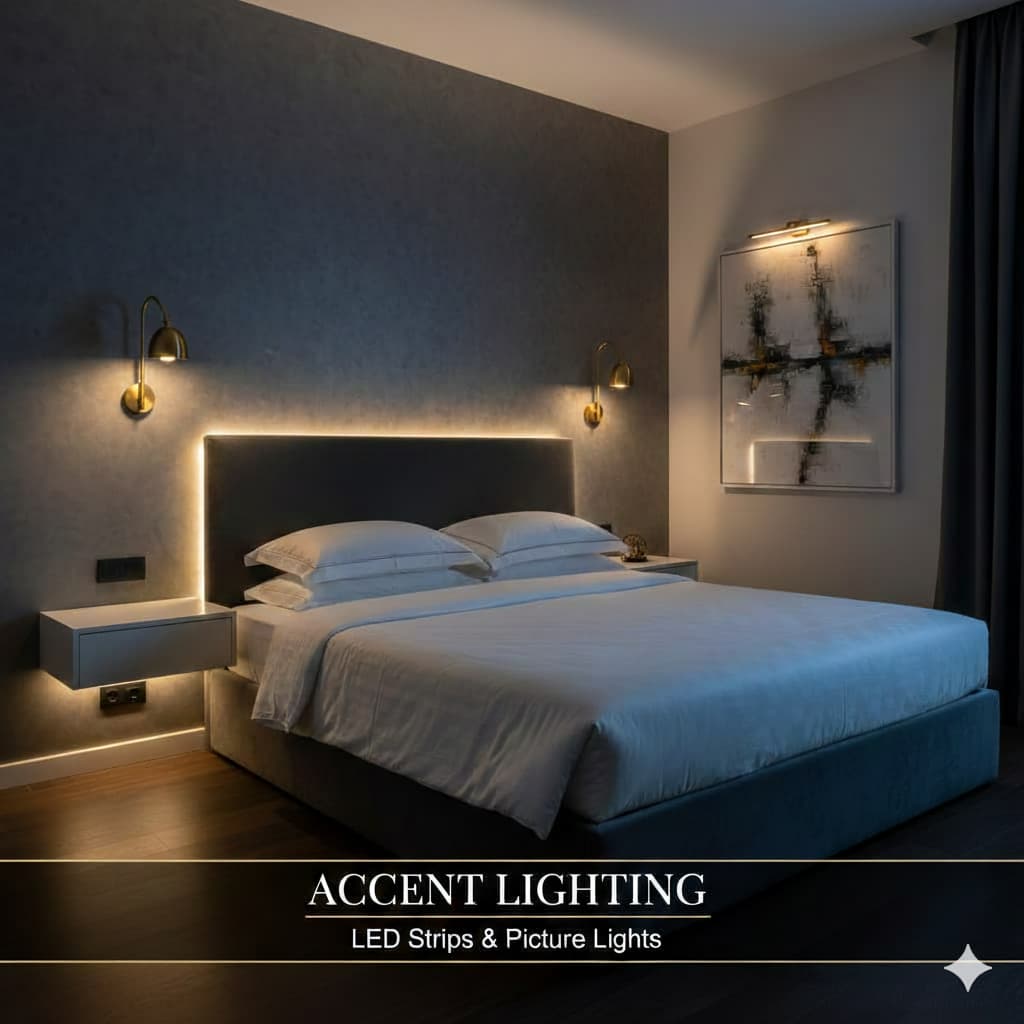
Creates visual interest and adjustable ambiance after dark.
LED strips under floating shelves or behind headboard: Soft indirect glow
Picture lights on artwork: Highlights wall decor and adds warmth
String lights or fairy lights: More casual, works in teen bedrooms or bohemian styles
LIGHTING CONTROL:
Dimmer switches: Non-negotiable for bedroom overhead lighting. You need variable brightness for different times and activities.
Smart bulbs: Control brightness and color temperature via app or voice. Set schedules for gradual wake-up lighting or automatic dimming at bedtime.
Multiple switches: Three-way switches that control same lights from multiple locations (bedroom entrance and bedside)
LIGHTING MISTAKES TO AVOID:
Only overhead lighting: Creates harsh shadows, not relaxing
Cool white bulbs in bedroom: Feels clinical, not restful (stick with warm white 2700-3000K)
No bedside lighting: Forces you to get up to turn off overhead lights
Insufficient closet lighting: Makes selecting outfits difficult
BEDROOM LIGHTING BY TIME OF DAY:
Morning: Bright overhead lighting plus natural light for waking up and getting ready
Afternoon: Natural light supplemented by task lighting as needed
Evening: Dimmed ambient lighting plus bedside reading lights
Night: Only bedside lamps or small nightlights if needed for bathroom trips
Layer your lighting: Multiple light sources at different levels create flexibility for any activity or mood.
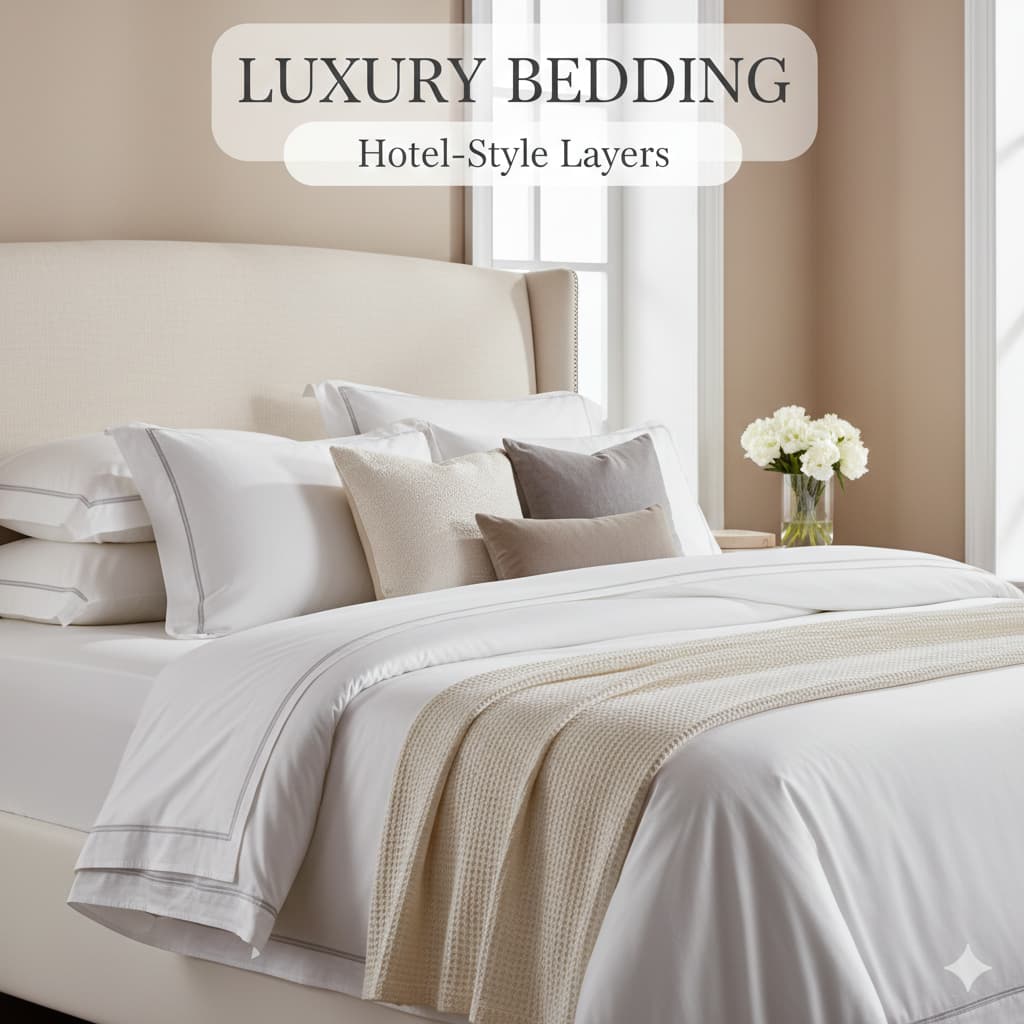
Let’s talk about what actually makes a bedroom feel comfortable: the soft stuff.
Your bed takes up roughly 40% of your bedroom’s visual space. What covers that bed matters a lot – both for comfort and aesthetics.
But here’s the thing most people get wrong: Expensive doesn’t automatically mean better. I’ve slept on $500 sheet sets that felt like sandpaper after three washes, and $60 sets that stayed soft for years.
What matters is understanding materials and construction, then choosing based on your actual preferences.
SHEET SELECTION:
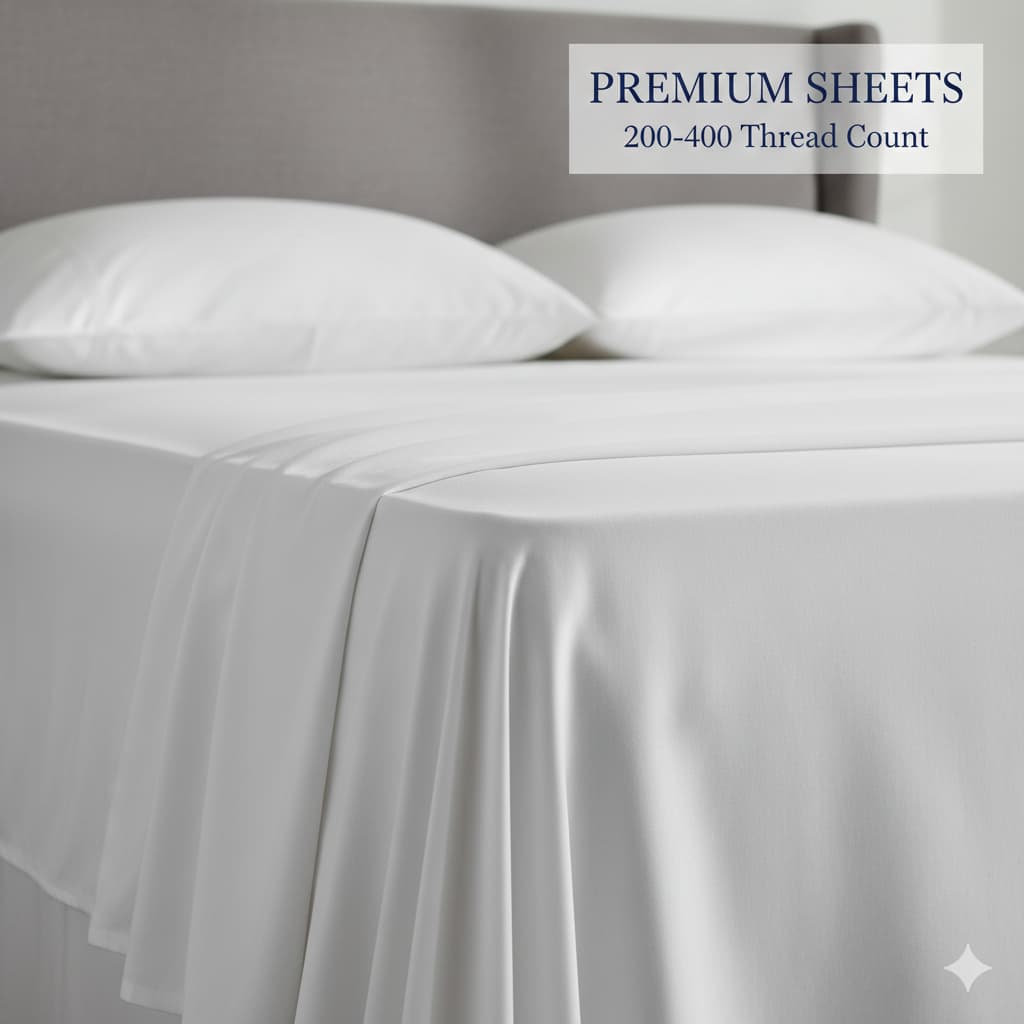
Thread count myths:
The bedding industry loves to advertise “1000 thread count!” like it means ultimate luxury. It doesn’t. Anything over 400-600 thread count is usually marketing nonsense – they’re either using thinner threads (which feel worse) or using sneaky counting methods.
Sweet spot: 200-400 thread count in quality materials
Material choices:
Cotton (most popular):
– Percale: Crisp, cool, matte finish – feels like hotel sheets
– Sateen: Silky, smooth, slight sheen – feels more luxurious but warmer
– Egyptian or Pima cotton: Longer fibers, softer and more durable
– Regular cotton: Perfectly fine for most people, just less soft than premium cottons
Linen:
– Naturally textured, gets softer with washing
– Breathable and cool in summer, insulating in winter
– Wrinkles easily (that’s part of the aesthetic)
– More expensive but extremely durable
Microfiber:
– Synthetic material (polyester)
– Very affordable, wrinkle-resistant
– Can feel hot because it doesn’t breathe like natural fibers
– Good budget option but not luxury
Bamboo or Tencel:
– Soft, breathable, moisture-wicking
– Eco-friendly marketing but production varies
– Pricier than cotton, similar feel to sateen
What to buy: If you sleep hot, get cotton percale or linen. If you like silky-smooth sheets, get cotton sateen. If budget is tight, get cotton with 200-300 thread count.
DUVET COVER vs COMFORTER:
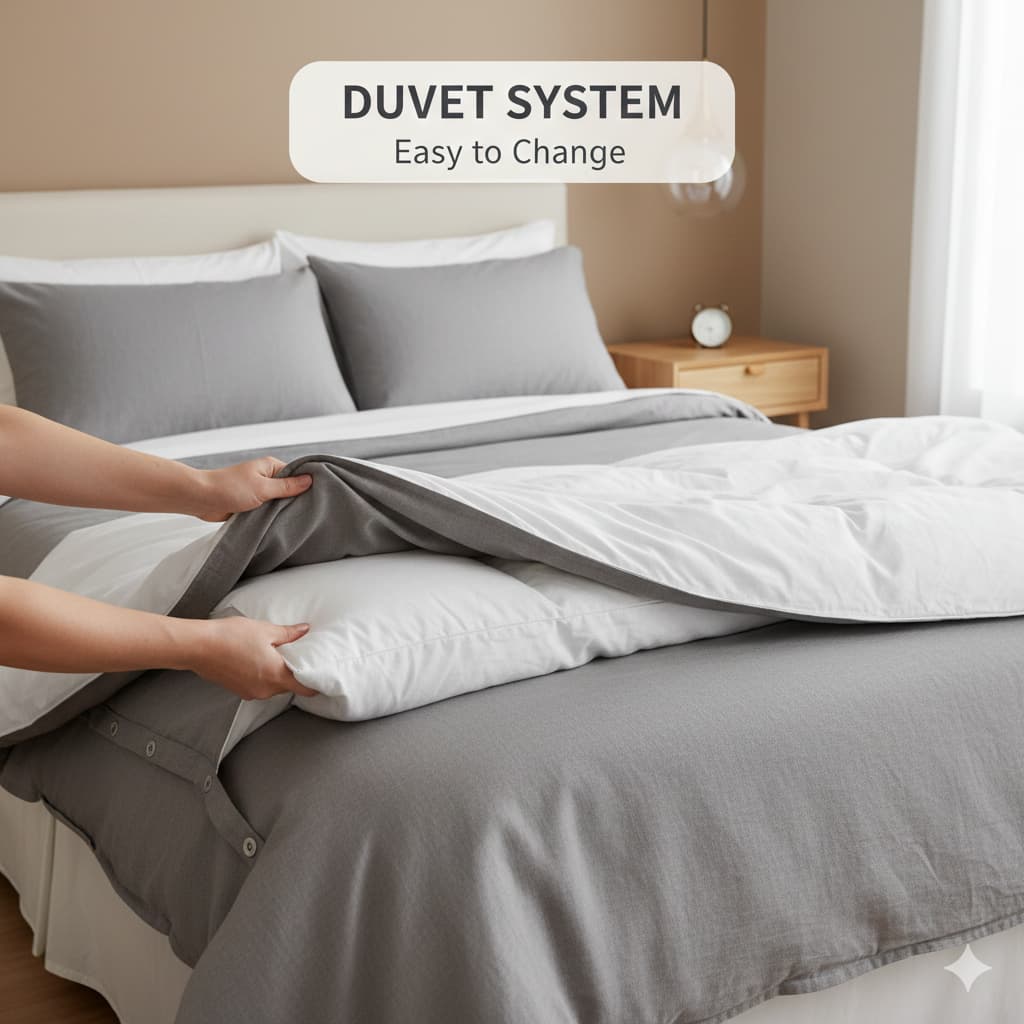
Duvet cover system:
A duvet is a soft flat bag filled with down or synthetic fill. The duvet cover is a removable, washable fabric case. You can change the look of your bed by swapping duvet covers.
Pros: Easy to wash (just remove cover), can change styles easily, customizable warmth
Cons: Requires tucking duvet into cover (annoying), duvet can shift inside cover
Comforter:
One piece – the fill and cover are sewn together. What you see is what you wash.
Pros: No assembly required, stays in place, often less expensive
Cons: Harder to wash (bulky), can’t change appearance, less customizable
Most people prefer the duvet system once they get used to it. More versatile and practical.
BLANKETS AND LAYERS:
Layering approach:
Instead of one heavy comforter, use multiple lighter layers. Flat sheet, lightweight blanket, duvet or quilt. Add or remove layers based on temperature.
Throw blankets:
Folded at foot of bed or draped over accent chair. Adds texture, color, and practical warmth. Choose material based on use – cotton for summer, chunky knit or faux fur for winter.
PILLOW SELECTION:
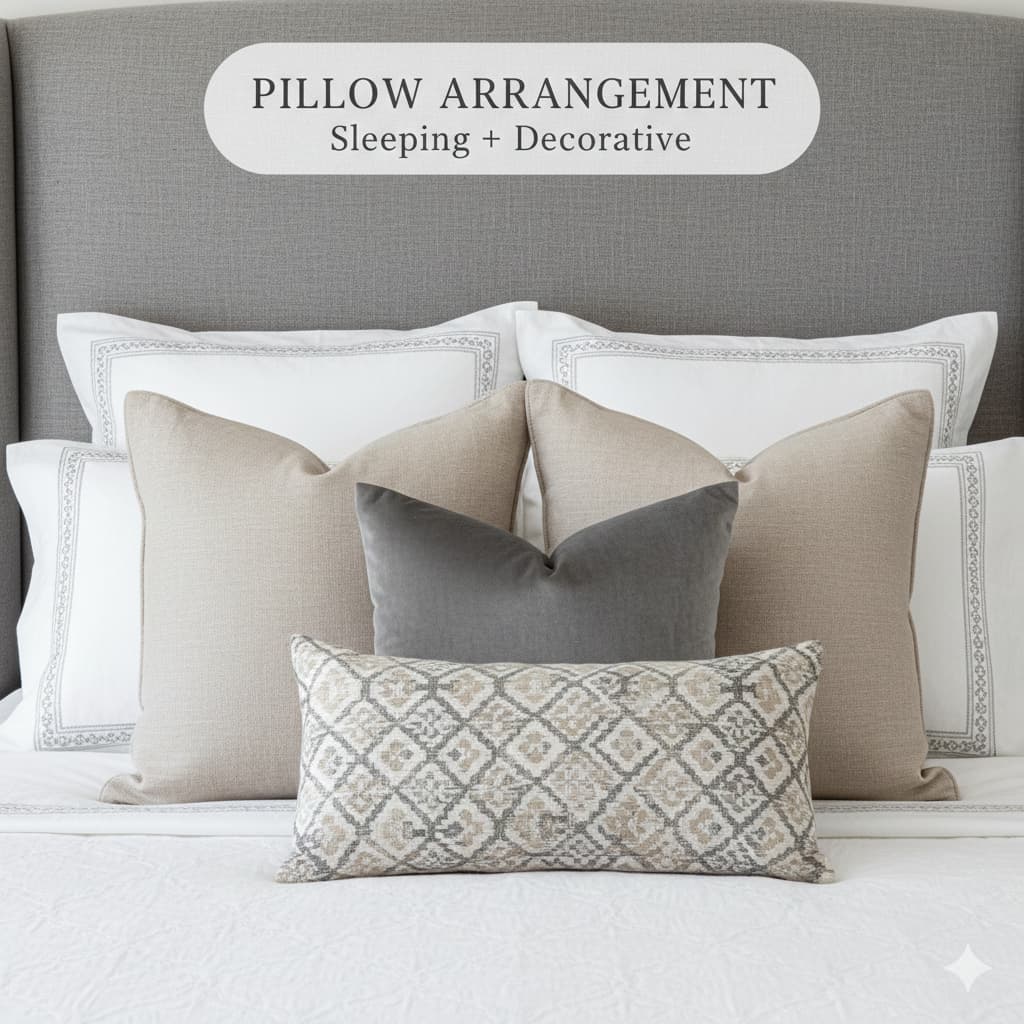
You need more than you think:
Sleeping pillows: 2-4 per person depending on sleep position
Standard size: 20×26 inches (most common)
King size: 20×36 inches (for king beds)
Side sleepers: Need firmer, thicker pillows to support head and neck alignment
Back sleepers: Medium-firm pillow that supports natural neck curve
Stomach sleepers: Soft, thin pillow to prevent neck strain
Decorative pillows (shams and throw pillows):
Purely aesthetic, not for sleeping. Remove before bed.
Standard arrangement for queen bed: 2 sleeping pillows, 2 standard shams, 2-3 small throw pillows
Standard arrangement for king bed: 2 sleeping pillows, 2-3 king shams or euro shams, 2-3 throw pillows
MAKING YOUR BED LOOK DESIGNED:
Basic layers (bottom to top):
1. Fitted sheet
2. Flat sheet
3. Blanket or duvet
4. Folded throw blanket at foot of bed
5. Sleeping pillows against headboard
6. Decorative pillows in front
Hotel-style bed making:
Fold top sheet and duvet down together about 12 inches from headboard, creating a cuff. Pillows stand upright against headboard. Crisp, clean look.
Casual layered look:
Duvet pulled up naturally (not perfectly smooth), sleeping pillows showing, one or two throw pillows. Comfortable, lived-in aesthetic.
WASHING AND CARE:
Sheets: Wash every 1-2 weeks in warm water, tumble dry low or line dry
Duvet cover: Wash every 2-4 weeks (or when it looks dirty)
Duvet insert: Wash 2-3 times per year or dry clean if it’s down-filled
Pillows: Wash every 3-6 months (if machine washable)
Textile quality dramatically impacts bedroom comfort levels and aesthetic appearance. Natural fiber selections including cotton, linen, and wool provide superior breathability and durability compared to synthetic alternatives, while maintaining appropriate care extends textile longevity and preserves desirable qualities.
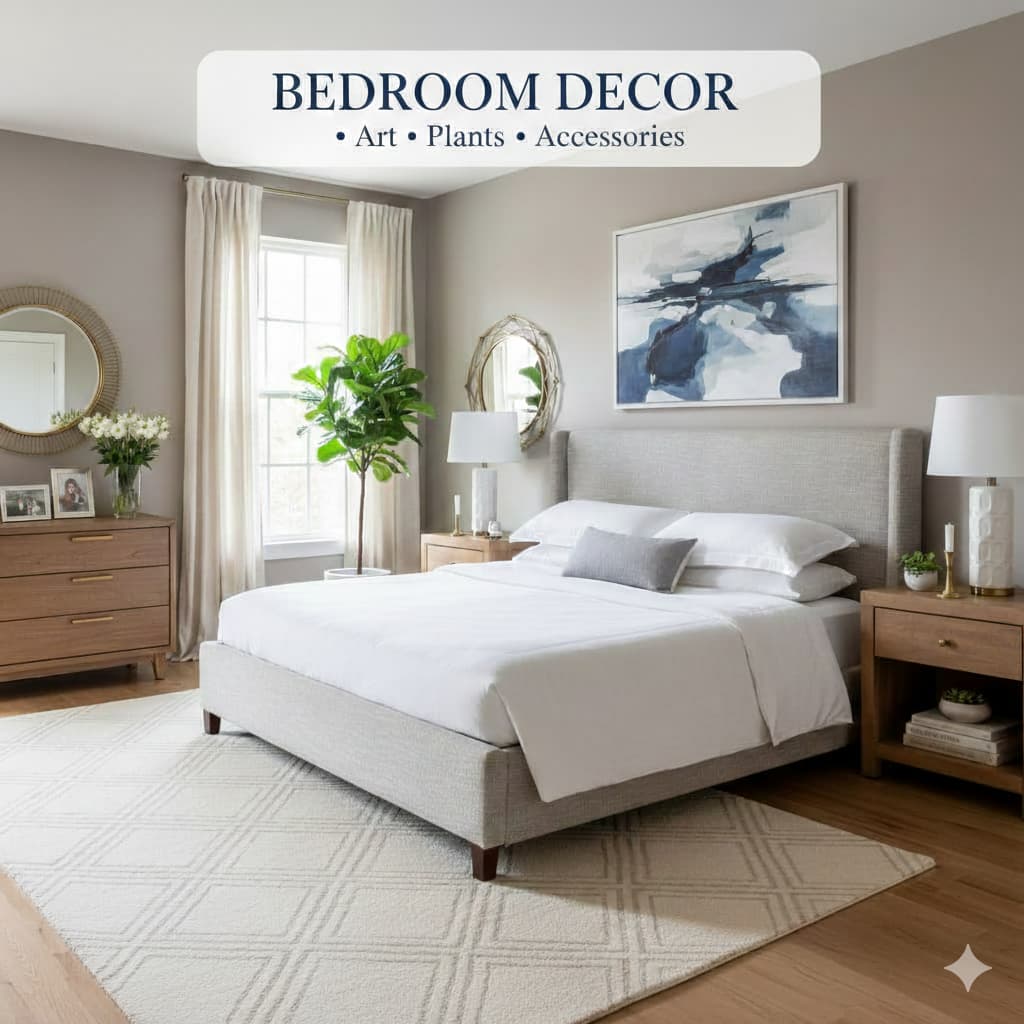
Okay, you’ve got the furniture in place, the lighting sorted, the bed properly made. Now comes the part that actually makes your bedroom feel like yours: the decor.
This is where most people either go way overboard (every surface covered in small decorative items) or way under (blank walls, zero personality). The sweet spot is somewhere in between.
WALL DECOR:
Artwork above bed:
The most common and effective spot for bedroom art. Scale matters here.
Size guide: Artwork should be 2/3 to 3/4 the width of your bed
Height: Center of artwork at 57-60 inches from floor, or 6-8 inches above headboard
Options: Large single piece, gallery wall arrangement, triptych
What to hang:
– Abstract art (universally appealing, won’t get tired of it)
– Photography or prints you love
– Not: Family photos (bedrooms should be restful, not emotional)
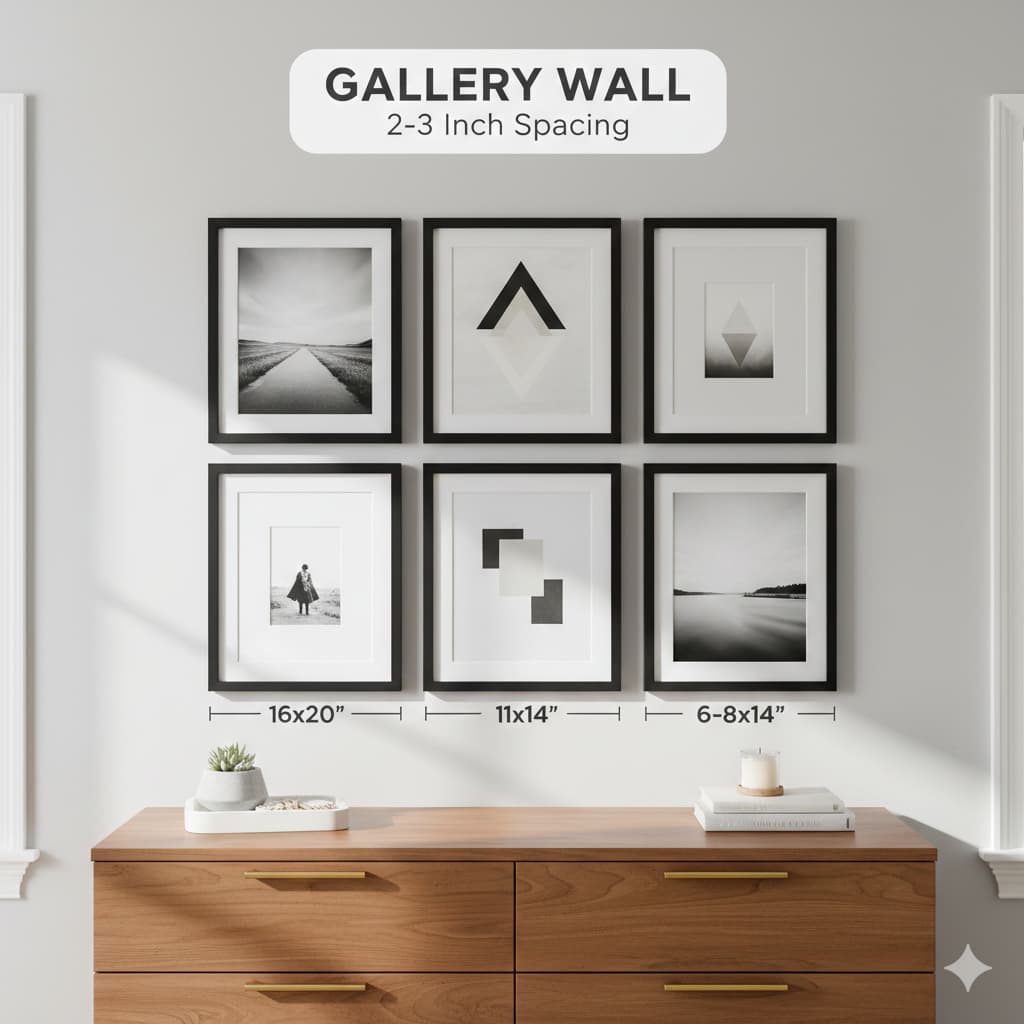
Gallery walls:
Works on side walls or above dresser. Not recommended above the bed unless your bedroom style is more eclectic or bohemian.
Layout: Plan on paper first, maintain 2-3 inches between frames, keep top and bottom edges aligned
Other wall sections:
Accent wall opposite bed, wall space beside windows, wall above dresser
MIRRORS:
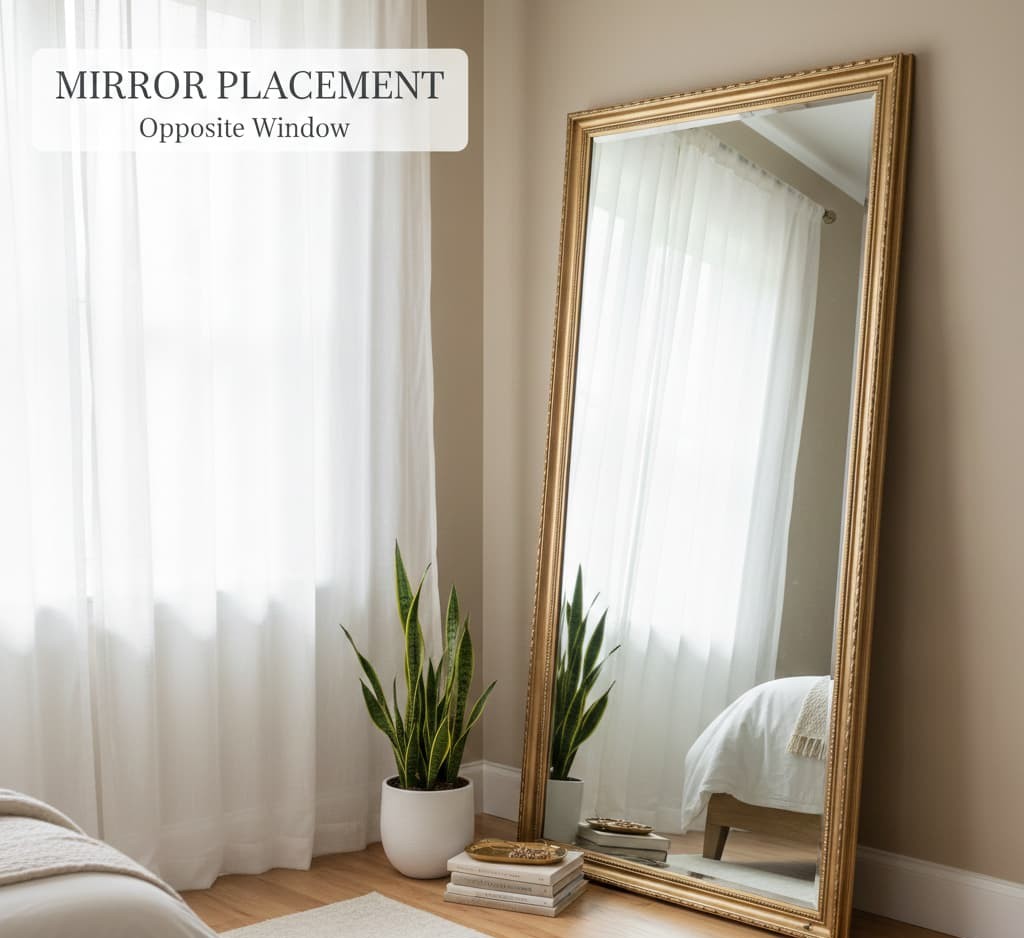
Full-length mirror: Essential for getting dressed. Can be freestanding, wall-mounted, or attached to closet door.
Position: Near your closet or dresser where you get dressed, with good natural or artificial lighting
Decorative mirrors: Round, arched, or interesting shapes add visual interest and reflect light
Where to place: Opposite windows to reflect light, above dresser, as part of gallery wall
What to avoid: Mirror facing bed if that bothers you (some people find it unsettling)
PLANTS:
Real plants: Add life, improve air quality, create calming environment
Best bedroom plants:
– Snake plant (low light, minimal care)
– Pothos (trailing plant for shelves)
– Peace lily (pretty, easy care)
– Rubber plant (larger statement plant)
Fake plants: Perfectly fine if you don’t want maintenance. Just choose quality fakes that look realistic.
Where to place: Window sills, dresser tops, corner floor plant stands, hanging planters
LIGHTING AS DECOR:
Statement lighting doubles as functional and decorative element.
Interesting table lamps on nightstands
Sculptural floor lamp in reading corner
Unique pendant lights as alternative to table lamps
Decorative string lights or edison bulbs
SURFACE STYLING:
Nightstands:
Keep these mostly functional, not decorative. You need surface space for phone, water glass, book.
Simple styling: Table lamp, small tray for jewelry/watch, one small decorative item or plant
Dresser top:
Can handle more styling because you don’t use this surface constantly.
Basic arrangement: Mirror or artwork leaning against wall, small tray for jewelry, one or two decorative objects (vase, candle, small plant)
Avoid: Covering entire surface with stuff – you need some functional space
RUGS:
Adds warmth, defines space, reduces noise on hard floors
Size guide:
Small bedrooms: 5×8 feet rug at foot of bed
Medium bedrooms: 6×9 feet or 8×10 feet rug extending partially under bed
Large master bedrooms: 8×10 feet or 9×12 feet rug with bed completely on rug
Placement:
– Centered under bed with equal extension on sides and foot
– Or positioned at foot of bed if bed is against wall
Material: Wool or cotton for bedrooms (soft underfoot), avoid scratchy materials
WINDOW TREATMENTS:
Functional and decorative – controls light, provides privacy, adds softness to room
Curtain length: Should touch floor or puddle slightly (1-2 inches on floor)
Curtain width: Panels should be 1.5-2x the width of window when closed
Rod height: Mount rod 4-6 inches above window frame (makes windows appear taller)
Style choices:
– Simple panels in solid colors (most versatile)
– Patterned curtains if walls are neutral
– Sheer curtains for light filtering
– Blackout curtains for light blocking
DECORATING MISTAKES TO AVOID:
Too many small items on surfaces (looks cluttered)
Artwork hung too high (common mistake – lower than you think)
Proportionally tiny rug (makes room look disconnected)
Mismatched metals throughout room (choose 2-3 metal finishes, stick with those)
Decorating before furniture is arranged (arrange furniture first, then add decor)
PERSONAL TOUCHES:
Your bedroom should reflect your interests and personality, not look like a hotel room or Instagram screenshot.
Books you’re actually reading
Travel souvenirs that mean something to you
Artwork or photos you genuinely love
Items that serve a function you need
The goal: Curated, not cluttered. Intentional, not sparse.
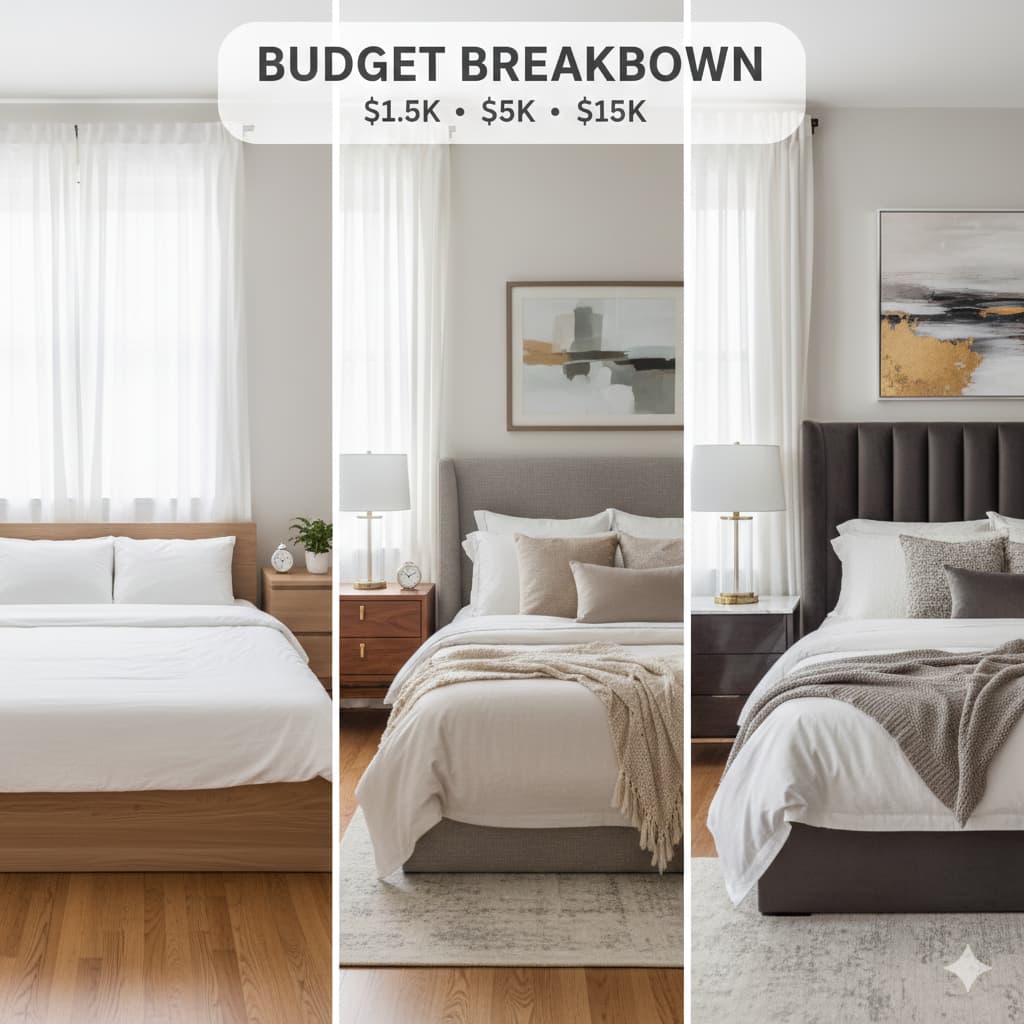
Let’s talk money. Because “design a beautiful bedroom” means nothing if you don’t know what it actually costs.
I’m going to give you real numbers for three budget levels: tight budget, moderate budget, and higher-end budget. These aren’t theoretical – they’re based on actual furniture and decor prices you’ll encounter.
TIGHT BUDGET BEDROOM: $1,500-2,500
This is “I just moved and need functional furniture without going into debt” budget.
Bed frame: $200-400
– Basic platform bed or metal frame
– IKEA, Amazon Basics, Wayfair budget lines
Mattress: $400-700
– Queen memory foam mattress-in-a-box
– Brands: Zinus, Linenspa, Amazon Basics
Nightstands: $80-150 each ($160-300 total)
– Simple 2-drawer or 1-shelf design
– Target, IKEA, HomeGoods
Dresser: $250-500
– 6-drawer style in laminate or basic wood
– IKEA, Target, Big Lots
Bedding: $150-250
– Sheets, duvet cover, pillows, throw blanket
– Target, Amazon, HomeGoods
Lighting: $100-200
– Two basic table lamps, overhead fixture if not included
– Target, IKEA, Amazon
Decor: $100-200
– Basic curtains, a few artwork prints, small accessories
– HomeGoods, TJ Maxx, Etsy prints
Total: $1,560-2,950
Reality check: This budget requires shopping sales, being patient, and prioritizing function over aesthetics. But it’s absolutely doable and your bedroom will be comfortable and functional.
MODERATE BUDGET BEDROOM: $3,500-6,000
This is “I want quality that’ll last and look good” budget. Most people aim for this range.
Bed frame: $500-1,000
– Solid wood or quality upholstered frame
– West Elm, Crate & Barrel, Room & Board outlet, Article
Mattress: $800-1,500
– Queen hybrid or quality memory foam
– Brands: Tuft & Needle, Casper, Purple, Saatva
Nightstands: $200-400 each ($400-800 total)
– Solid wood construction with good hardware
– West Elm, CB2, local furniture stores
Dresser: $700-1,200
– 6-9 drawer solid wood dresser with quality glides
– Crate & Barrel, Room & Board, local furniture makers
Bedding: $400-700
– Quality cotton or linen sheets, down alternative duvet, good pillows
– Parachute, Brooklinen, Pottery Barn
Lighting: $300-500
– Quality table lamps, maybe wall sconces or pendant lights
– West Elm, CB2, Rejuvenation
Decor: $400-800
– Custom curtains, framed artwork, area rug, plants, accessories
– Mix of sources: Etsy, local artists, HomeGoods, online retailers
Total: $3,600-6,500
Reality check: This budget gets you furniture that’ll last 10-15 years, looks significantly better than budget options, and feels intentionally designed.
HIGHER-END BUDGET BEDROOM: $8,000-15,000+
This is “I want investment-quality furniture and designer aesthetics” budget.
Bed frame: $1,500-3,000
– Custom or designer upholstered bed, heirloom-quality wood frame
– Room & Board, Design Within Reach, local custom makers
Mattress: $2,000-4,000
– Luxury hybrid, organic materials, or high-end memory foam
– Brands: Avocado, Saatva luxury line, Tempur-Pedic
Nightstands: $500-1,000 each ($1,000-2,000 total)
– Designer pieces or custom-made solid wood
– Designer brands or commissioned furniture
Dresser: $1,500-3,000
– Heirloom-quality solid wood with premium hardware
– Design Within Reach, Room & Board, custom furniture makers
Bedding: $800-1,500
– Premium linen or Egyptian cotton sheets, down duvet, luxury pillows
– Parachute luxury line, Boll & Branch, Sferra
Lighting: $800-1,500
– Designer table lamps, custom sconces or pendants
– Designer brands, Schoolhouse Electric, custom lighting
Decor: $1,000-2,500
– Custom window treatments, original artwork, handmade rug, curated accessories
– Interior designer or custom sources
Total: $8,600-17,500
Reality check: This budget is for people who view furniture as long-term investment, want pieces that’ll last 20+ years, and prioritize quality and design over saving money.
Complete Budget Comparison:
Item | Tight Budget | Moderate Budget | Higher-End Budget |
Bed Frame | $200-400 | $500-1,000 | $1,500-3,000 |
Mattress | $400-700 | $800-1,500 | $2,000-4,000 |
Nightstands (pair) | $160-300 | $400-800 | $1,000-2,000 |
Dresser | $250-500 | $700-1,200 | $1,500-3,000 |
Bedding | $150-250 | $400-700 | $800-1,500 |
Lighting | $100-200 | $300-500 | $800-1,500 |
Decor & Accessories | $100-200 | $400-800 | $1,000-2,500 |
TOTAL COST | $1,560-2,950 | $3,600-6,500 | $8,600-17,500 |
BUDGET ALLOCATION RECOMMENDATIONS:
Where to splurge:
– Mattress (directly affects sleep quality and health)
– Bed frame (you use it every day, quality makes a difference)
– Bedding (spends most time in contact with your skin)
Where to save:
– Nightstands (simpler construction, less critical)
– Decorative items (personal taste changes, keep flexible)
– Accent furniture like benches or chairs (less frequently used)
PHASED APPROACH:
Don’t have the full budget right now? Buy in phases:
Phase 1 (Essential): Bed frame, mattress, basic bedding ($1,000-2,000)
Phase 2 (Functional): Nightstands, dresser, lighting ($800-1,500)
Phase 3 (Finishing): Decor, upgraded bedding, final touches ($500-1,000)
This spreads costs over several months while keeping your bedroom functional.
COST-SAVING STRATEGIES:
Shop floor models and displays: 20-40% off retail
Buy during major sales: President’s Day, Memorial Day, Labor Day, Black Friday
Check outlet stores: West Elm Outlet, CB2 Outlet, Room & Board Outlet
Consider quality used: Vintage or secondhand solid wood furniture often costs less and is better quality than new cheap furniture
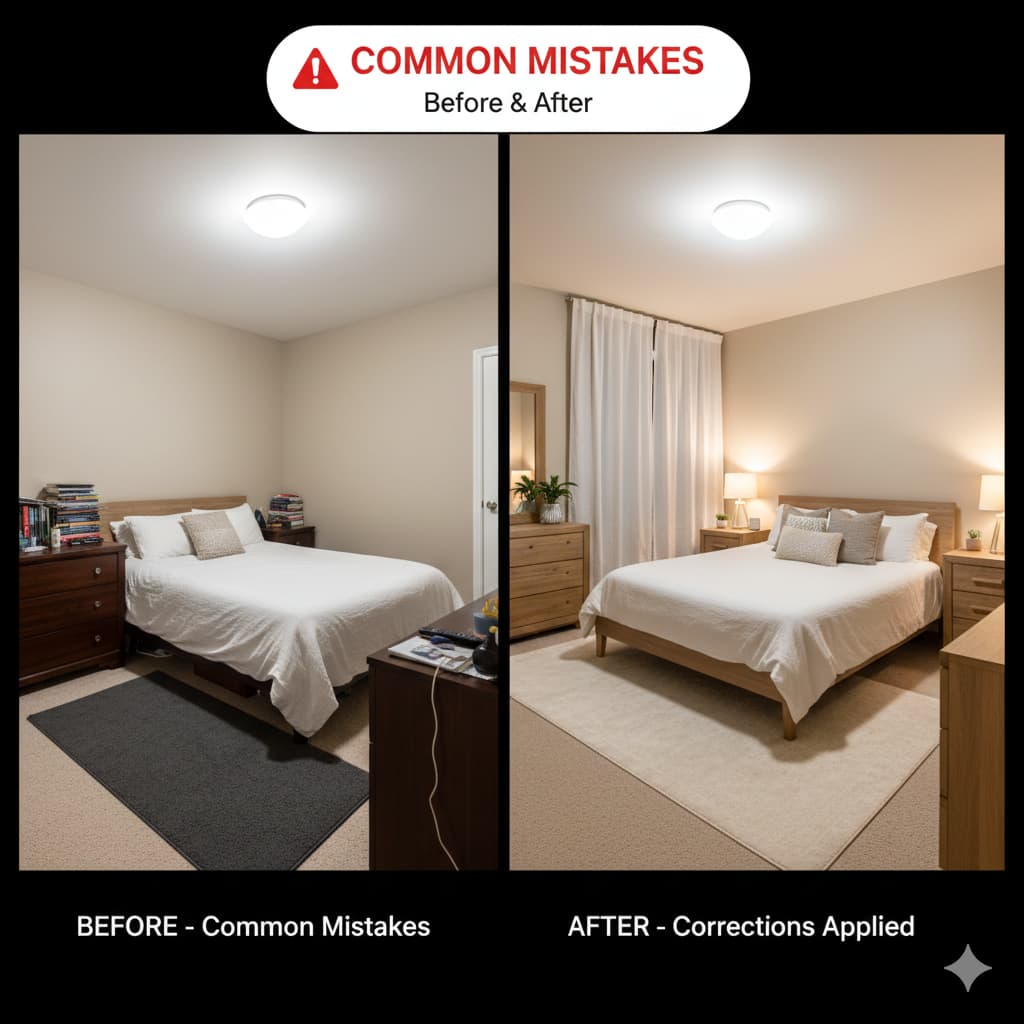
Let’s talk about what NOT to do. Because avoiding mistakes is sometimes more important than following rules.
I’ve seen (and fixed) these problems countless times. They’re incredibly common and surprisingly easy to avoid once you know what to look for.
MISTAKE 1: BED AGAINST THE WRONG WALL
Putting your bed wherever it fits instead of where it functions best.
Why it’s wrong: Your bed should be visible from the doorway (creates focal point) and allow for clearance on both sides (accessibility and balance).
The fix: Center your bed on the longest uninterrupted wall, ideally opposite the doorway. If that doesn’t work due to windows or doors, choose the wall that allows the most clearance on at least one side.
MISTAKE 2: UNDERSIZED RUG
Using a tiny rug that looks like a bathroom mat under a bed.
Why it’s wrong: Makes the room look disconnected and furniture feel like it’s floating randomly in space.
The fix: Rug should extend under bed and at least 18-24 inches beyond on sides and foot. For queen bed, minimum 6×9 feet rug. For king bed, minimum 8×10 feet rug.
MISTAKE 3: INSUFFICIENT BEDSIDE LIGHTING
Relying only on overhead lighting, no bedside lamps or reading lights.
Why it’s wrong: Forces you to get up to turn off lights before bed. Creates harsh lighting when you want ambient, relaxed atmosphere.
The fix: Add bedside table lamps, wall-mounted reading lights, or pendant lights. Each person should have independently controlled lighting.
MISTAKE 4: PUSHING ALL FURNITURE AGAINST WALLS
Shoving every piece of furniture flat against walls in small bedrooms.
Why it’s wrong: Creates a disconnected, dorm-room feeling. Doesn’t actually make the room feel bigger.
The fix: In rooms 12×12 feet or larger, float the bed 6-12 inches from the wall. Creates a more intentional, designed look.
MISTAKE 5: WRONG SIZED NIGHTSTANDS
Nightstands that are way too tall or too short relative to mattress height.
Why it’s wrong: Looks visually awkward, functionally annoying to reach for items.
The fix: Nightstand top should be level with mattress height or 2-3 inches lower. Measure your mattress height before buying nightstands.
MISTAKE 6: NO WINDOW TREATMENTS
Leaving windows bare or with cheap plastic blinds.
Why it’s wrong: Light control issues, privacy concerns, room feels unfinished.
The fix: Add curtain panels even if you also have blinds. Curtains soften the room and add warmth. Hang curtain rod 4-6 inches above window frame, let panels touch the floor.
MISTAKE 7: OVERHEAD-ONLY LIGHTING
Single ceiling light on a basic switch, no dimmer, no layered lighting.
Why it’s wrong: Creates harsh, unflattering light. Can’t adjust for different activities or times of day.
The fix: Add dimmer to overhead light. Add bedside lamps. Add accent lighting if desired. Layer your light sources.
MISTAKE 8: WALLS TOO DARK FOR ROOM SIZE
Painting small bedrooms in dark colors that make them feel cave-like.
Why it’s wrong: Dark colors absorb light and make small spaces feel smaller and more closed-in.
The fix: Use light, neutral colors in bedrooms under 150 square feet. Save dark dramatic colors for larger master bedrooms with plenty of natural light.
MISTAKE 9: ARTWORK HUNG TOO HIGH
Hanging pictures way above the recommended 57-60 inch center height.
Why it’s wrong: Creates a disconnected feeling, makes ceilings look lower, looks awkward.
The fix: Measure 57-60 inches from floor to center of artwork. For art above furniture, hang 6-8 inches above the furniture top.
MISTAKE 10: MATCHING BEDROOM SET
Buying a complete matching bedroom furniture set (bed, nightstands, dresser).
Why it’s wrong: Looks staged and impersonal, like a furniture showroom. Often includes pieces you don’t actually need.
The fix: Choose bed and dresser based on what you need. Add nightstands that complement but don’t necessarily match exactly. Mix finishes for more interesting, personal look.
MISTAKE 11: CLUTTERED SURFACES
Covering nightstands, dresser tops, shelves with too many small decorative items.
Why it’s wrong: Creates visual chaos, makes room feel messy even when it’s clean.
The fix: Follow the “less is more” principle. Keep nightstands functional (lamp, phone, maybe one small item). Dresser can have a few curated pieces but needs functional space too.
MISTAKE 12: IGNORING SCALE AND PROPORTION
Putting oversized furniture in small bedrooms or tiny furniture in large bedrooms.
Why it’s wrong: Makes room feel either cramped or empty and disconnected.
The fix: Measure your room, then measure furniture before buying. In small bedrooms, choose appropriately-scaled pieces. In large bedrooms, don’t be afraid of substantial furniture.
MISTAKE 13: NO PERSONAL STYLE
Following trends too literally, creating a room that looks like a Pinterest screenshot instead of reflecting your personality.
Why it’s wrong: Your bedroom should feel like yours, not a magazine spread.
The fix: Include items that mean something to you. Mix trending items with personal touches. Don’t be afraid to break “rules” if something makes you happy.
MISTAKE 14: CHEAP MATTRESS
Spending money on furniture but skimping on the mattress.
Why it’s wrong: You spend 1/3 of your life on that mattress. Quality directly affects sleep, which affects everything else in your life.
The fix: Prioritize mattress in your budget. It’s more important than any furniture piece.
MISTAKE 15: NEVER UPDATING
Living with the same bedroom setup for 10+ years without refreshing anything.
Why it’s wrong: Your needs change, styles evolve, furniture wears out. An outdated bedroom affects your mood.
The fix: Small updates make a big difference. New bedding, fresh paint, updated lighting – you don’t need to replace everything, just refresh.
Avoiding these common pitfalls creates functional, attractive bedroom spaces from the start.