
kitchen-island-ideas-2026
Let me tell you something I see constantly when homeowners reach out to me about their kitchen renovations. They walk into a showroom, fall in love with a gorgeous oversized island, buy it on the spot, and then call me two weeks later completely defeated because the thing barely leaves room to open the refrigerator door. Yeah, I’ve seen this mistake a thousand times. A kitchen island is arguably the most transformative element you can add to your cooking space, but it’s also the most misunderstood. Too big, too small, wrong shape, wrong height, the wrong material for your lifestyle. The dream becomes a daily frustration faster than you’d expect.Here’s the thing though. When a kitchen island is planned correctly, it changes everything. It adds prep space, creates natural traffic flow, defines the kitchen zone in an open plan layout, and honestly becomes the social heartbeat of your entire home. According to a 2023 report published by the National Kitchen and Bath Association (NKBA), kitchen islands are now included in over 76% of new kitchen designs in the United States, making them the single most requested feature in kitchen remodels. That number tells you everything you need to know about how central this piece of furniture has become to American home life.In this guide, I’m covering everything from island sizing rules and clearance requirements to the hottest 2026 design trends, material choices, seating configurations, lighting strategies, and the real costs you should be budgeting for. Whether you’re working with a compact (10×10 foot) kitchen or a sprawling open plan space, I’ve got ideas and solutions that will actually work for your home. I’ve broken everything down into sections so you can jump to whatever is most relevant to you right now.I’m Sophia Rose, and I’ve been writing about home decor and interior design for NineSeasDecor.com for years. I work closely with kitchen designers, contractors, and real homeowners every single week, which means the advice I’m sharing here isn’t pulled from a generic template. It’s grounded in real projects, real budgets, and real kitchens. I’ve personally consulted on dozens of island installations and watched both the successes and the disasters unfold. Trust me, you want to read this before you make any decisions.
Understanding Kitchen Island Sizing And Clearance Rules
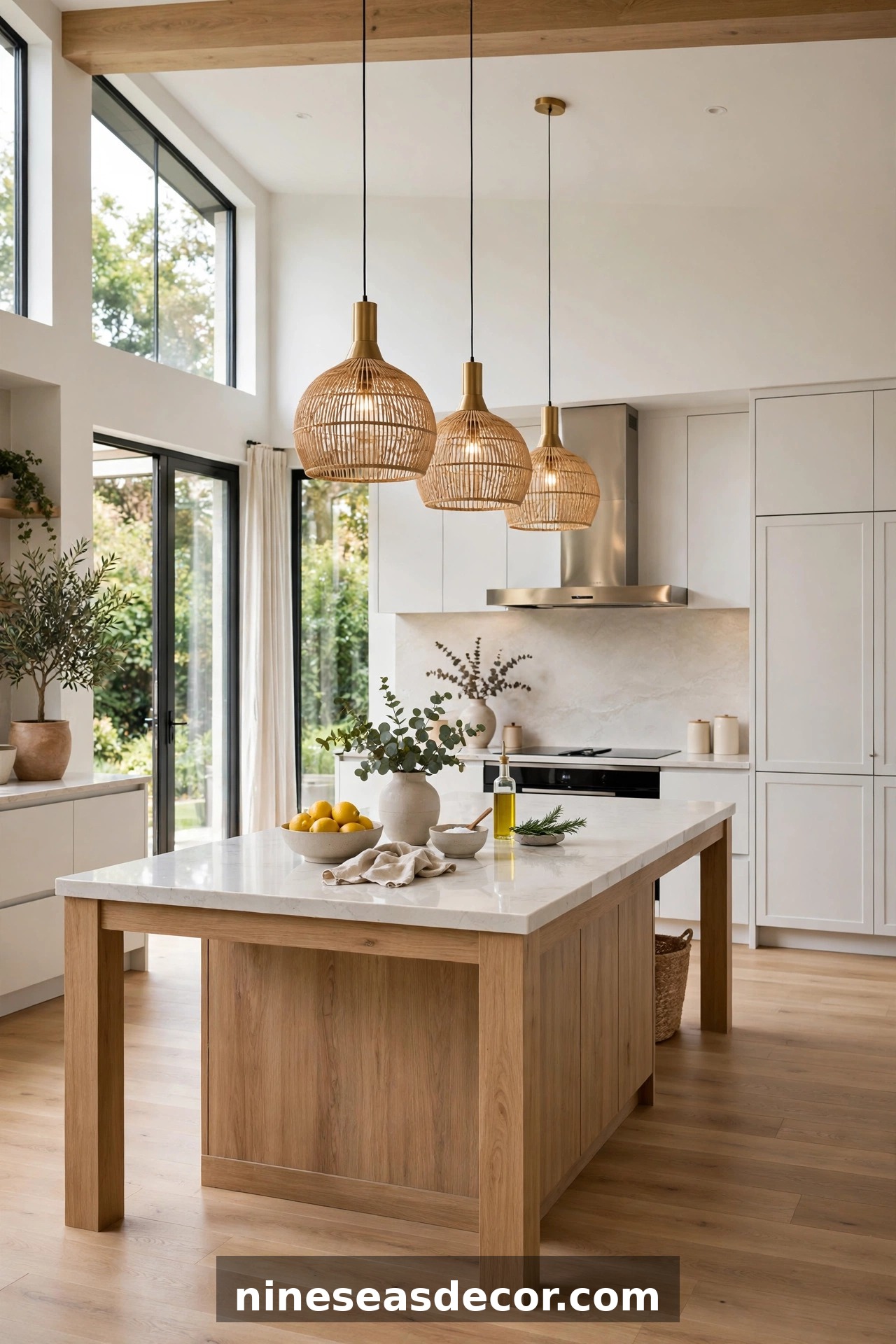
This is the section most people skip, and it’s the reason so many kitchen islands end up being more obstacle than asset. Before you even think about style or materials, you need to nail down the correct island dimensions for your specific kitchen footprint. Getting this wrong is expensive and frustrating to fix after the fact.
The general rule of thumb that professional kitchen designers use is this. Your kitchen island needs a minimum of 42 inches of clearance on all sides for a single cook household. If you have multiple people regularly cooking at the same time, which is extremely common in family homes, you want to bump that up to 48 inches of clearance on the working sides. That clearance isn’t just about comfort, it’s about safety, it’s about being able to open appliance doors fully, and it’s about allowing someone to walk behind you while you’re standing at the stove without either of you performing a sideways shuffle.
In terms of the island itself, the absolute minimum recommended size is 2×4 feet (24×48 inches) for a functional prep surface. But honestly, anything under 3×6 feet (36×72 inches) is going to feel cramped the moment you start actually cooking on it. Most of the islands I recommend for standard kitchens fall in the 3×5 foot to 4×7 foot range, which gives you genuine workspace without swallowing your kitchen alive.
According to a 2024 consumer survey published by Houzz, homeowners who took the time to create a scaled floor plan before purchasing or building their kitchen island reported 71% fewer layout complaints after installation compared to those who estimated by eye. That statistic is pretty humbling when you think about how many people skip the planning step because it feels tedious.
HOW TO MEASURE YOUR KITCHEN FOR AN ISLAND
Start by measuring the total kitchen footprint in feet, length by width. Then subtract the space occupied by your existing cabinetry runs on each wall. What you’re left with is your open floor area. From that open area, you subtract the required clearances on all four sides of where you envision the island sitting. Whatever space remains in the center is the maximum island footprint you can work with. So for a (14×16 foot) kitchen with standard (24 inch deep) base cabinets on two walls, you’d be working with roughly (10×12 feet) of open space. Subtract (42 inches) of clearance from each walkable side, and you land on a comfortable island size of approximately (3×5 feet). Write these numbers down and take them with you when you shop. Seriously, don’t rely on memory or eyeballing.
STANDARD ISLAND HEIGHT OPTIONS AND WHEN TO USE THEM
Most kitchen islands are built to standard counter height, which is (36 inches tall). This matches your existing countertops and makes for a seamless, unified look. However, there are two other heights worth knowing about. Bar height islands sit at (42 inches tall) and work beautifully for seating configurations using bar stools. Then there’s the increasingly popular two tier island design, which combines a (36 inch) prep surface on one side with a (42 inch) raised bar on the seating side. This is a brilliant solution because it conceals meal prep mess from guests sitting at the island. The right height really depends on how you use the space, who uses it, and whether you’re prioritizing seating functionality or cooking workflow above all else.
MINIMUM KITCHEN SIZE REQUIREMENTS FOR AN ISLAND
This is the hard truth that a lot of people don’t want to hear. If your kitchen is smaller than (12 feet wide) in its shortest dimension, a permanent fixed island is probably not going to serve you well. You’ll constantly feel cramped and the island will impede more than it helps. However, that doesn’t mean you’re out of options. A rolling kitchen cart island in the (24×36 inch) range can give you extra prep surface when you need it and can be tucked away when you don’t. For kitchens between (12 and 14 feet wide), a slim, narrow island around (24 inches deep by 48 to 60 inches long) can work really well. For anything (14 feet wide or more), you have serious room to play with design.
The Most Popular Kitchen Island Styles For 2026
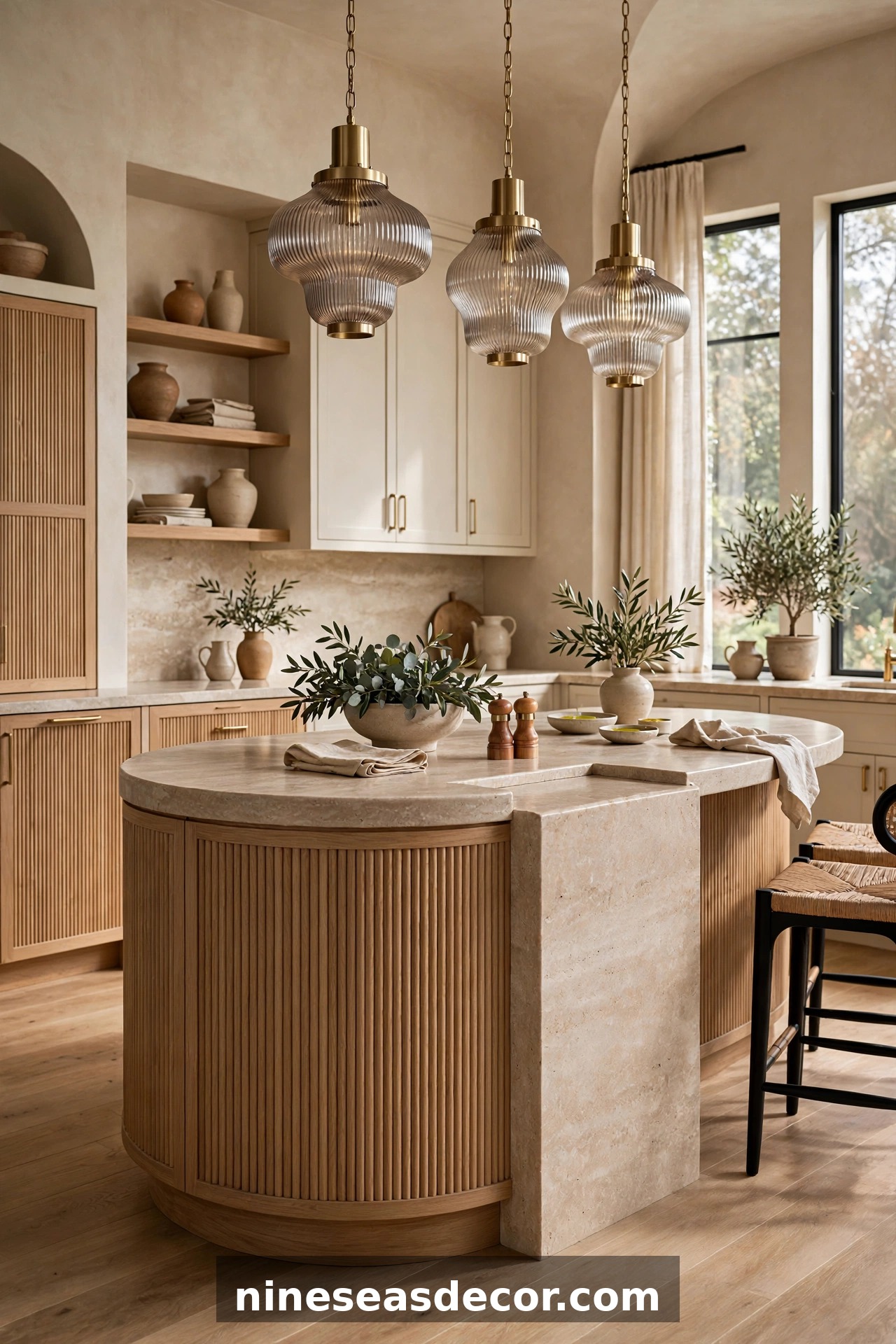
Design trends in the kitchen space move fast, and what looked fresh in 2022 can already feel dated in 2026. That said, some styles have real staying power because they’re rooted in function as much as aesthetics. The best kitchen island ideas for 2026 sit at the intersection of beautiful and practical, which is exactly where I always want my clients to land.
The biggest shift I’m seeing right now is the move away from the uniform, matching everything approach. Homeowners are getting bolder and smarter. They’re choosing islands that contrast with their surrounding cabinetry in color, material, or finish. A white shaker kitchen with a navy island, a natural wood kitchen with a black marble topped island, these combinations feel sophisticated and intentional rather than matchy matchy. This is a trend with real longevity because it’s backed by design principle, not just fashion.
Another major direction for 2026 is the unfitted or furniture style island. Think vintage baker’s tables, repurposed antique consoles, or custom pieces that look like they were always meant to be furniture rather than built ins. This approach works especially well in farmhouse, eclectic, and transitional kitchens where you want warmth and personality. According to the American Society of Interior Designers (ASID) 2025 Trends Report, 58% of designers cited the furniture inspired kitchen as the dominant residential kitchen aesthetic heading into 2026. That’s a massive shift from the sleek, integrated look that dominated the 2010s.
Waterfall edge islands, statement lighting over islands, mixed material islands, and island seating that wraps around multiple sides are all huge right now. I’ll break each of these down in detail below so you can figure out which direction actually makes sense for your home and lifestyle.
THE WATERFALL ISLAND TREND EXPLAINED
A waterfall island is when the countertop material extends down the sides of the island all the way to the floor, creating a continuous, unbroken surface that flows like, well, a waterfall. This look is particularly stunning in book matched marble, quartzite, or high quality quartz. The visual effect is dramatic and luxurious. Cost wise, a waterfall island adds roughly ($500 to $1,500) to your countertop fabrication bill depending on the material and the complexity of the mitered corner joints. In premium stones like Calacatta marble or exotic quartzite, the cost can go higher. It’s a splurge, but one that delivers genuine wow factor and photographs beautifully, which matters if you ever plan to sell.
CONTRASTING COLOR ISLANDS THAT WORK IN 2026
The contrasting island is my personal favorite trend right now because it’s accessible at almost any budget. You can paint an existing island a new color for as little as ($100 to $300) in materials, or you can build a new island with contrasting cabinet boxes and fronts. The key is choosing colors that genuinely complement each other rather than simply clash. Some of my favorite combinations right now include Sherwin-Williams Naval (SW 6244) against white perimeter cabinets, Benjamin Moore Newburyport Blue (HC-155) paired with natural oak uppers, and the incredibly chic Sherwin-Williams Tricorn Black (SW 6258) island against a warm cream or greige kitchen. If you’re going for a warmer earthy palette, Benjamin Moore Coventry Gray (HC-169) makes a stunning island color in transitional kitchens. Always test your paint on a large piece of cardboard and live with it in your actual kitchen lighting for a full day before committing.
FURNITURE STYLE AND UNFITTED ISLAND IDEAS
The furniture style island trend is about making your kitchen feel less like a sterile cooking laboratory and more like a living space that happens to have a stove in it. This can mean using turned legs instead of a solid base, incorporating open shelving on one or more sides instead of closed cabinet doors, using reclaimed wood as the island material, or literally repurposing an antique piece of furniture with a new top installed. A large antique dining table makes a spectacular island in a farmhouse or cottage style kitchen. The warmth and imperfection of aged wood brings so much character to the space. Budget for this approach can vary wildly, from ($300 to $800) for a thrifted or vintage piece with a new butcher block top, all the way to ($5,000 to $12,000) for a custom built furniture style island with premium materials.
Kitchen Island Countertop Materials: What Actually Holds Up
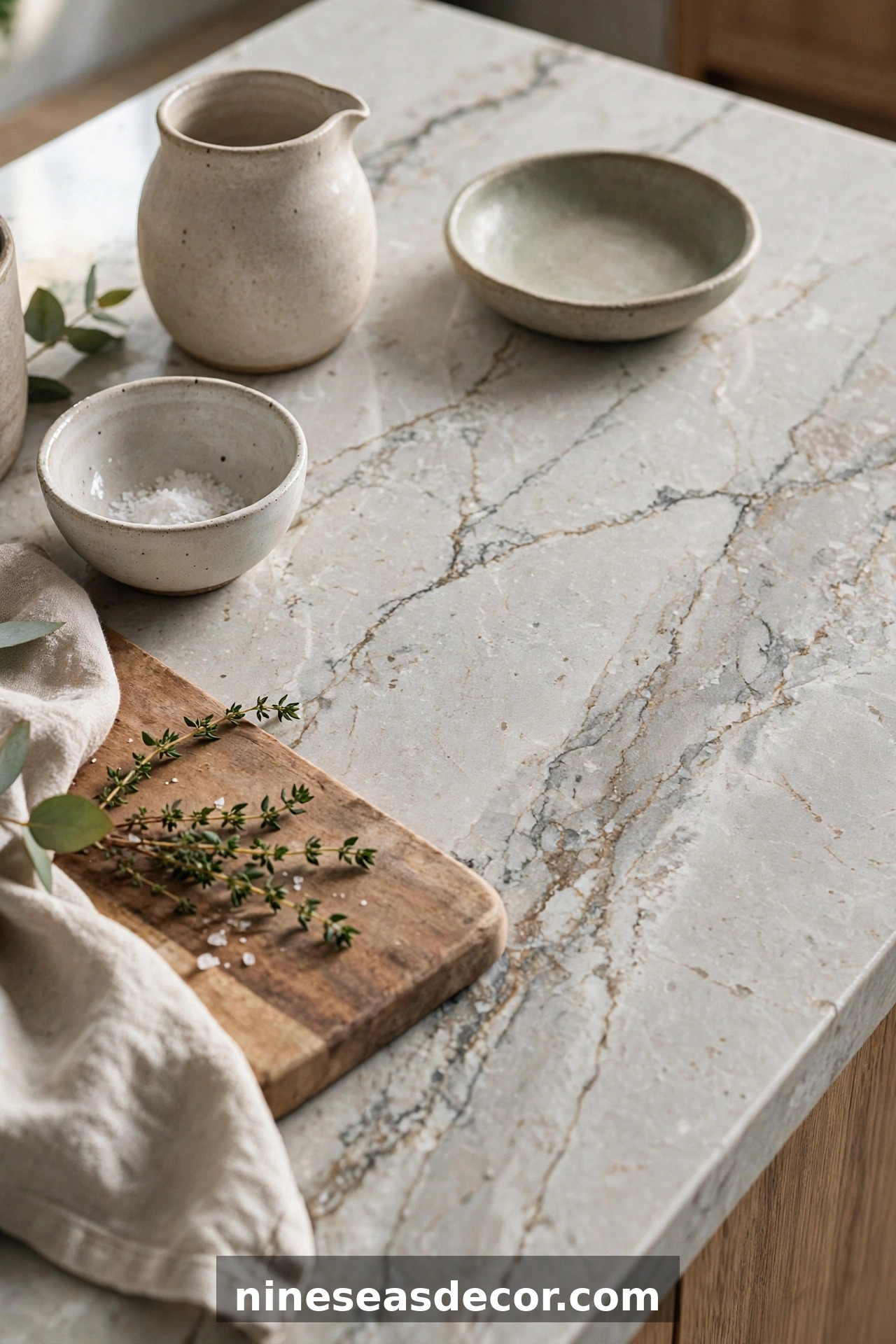
Here’s where I get brutally honest with you, because I’ve watched too many homeowners fall in love with a beautiful material that’s completely wrong for their actual lifestyle. Your island countertop is going to take more abuse than any other surface in your kitchen. It’s where you chop vegetables, roll dough, set down heavy pots, let kids do homework, and host everything from cocktail parties to coffee mornings. The material has to be beautiful, yes, but it has to be resilient.
The market for kitchen countertop materials has exploded in recent years. You’re no longer choosing between granite and laminate. Today’s options include engineered quartz, natural marble, quartzite, porcelain slab, butcher block, concrete, soapstone, dekton, and high end laminate that genuinely mimics stone. Each material has a distinct personality, a specific maintenance requirement, and a price point that can vary enormously based on the slab, the fabricator, and your region of the country.
According to a 2024 consumer behavior study published in the Journal of Housing and the Built Environment, durability and ease of maintenance ranked as the top two priorities for US homeowners when selecting kitchen countertop materials, outranking both cost and aesthetics. That’s a meaningful shift from what we saw a decade ago, when visual appeal dominated purchasing decisions almost completely. Homeowners are getting smarter and more practical, and I’m here for it.
ENGINEERED QUARTZ VS NATURAL STONE FOR ISLANDS
Engineered quartz remains the most popular island countertop material in the US for good reason. It’s non porous, which means it resists staining without any sealing. It’s extremely hard and difficult to chip or scratch under normal use. It comes in an enormous range of colors and patterns, including very convincing marble looks. Cost runs from ($75 to $150 per square foot) installed, depending on brand and complexity. Natural marble, on the other hand, is magnificent but etches easily from acidic foods like lemon juice and wine, and it requires regular sealing. It’s gorgeous in low traffic display kitchens but can be a source of constant anxiety in a busy family kitchen. If you love the marble look, I almost always recommend a high quality quartz marble alternative or a porcelain slab for island surfaces. You’ll get the beauty without the heartache.
BUTCHER BLOCK ISLANDS: THE HONEST TRUTH
Butcher block is romantic and warm and it photographs incredibly well. It’s also a very committed relationship. You need to oil it regularly (every one to three months depending on use), it will stain if you’re not careful, it can warp if it gets excessively wet, and it will show knife marks over time. That said, many of those characteristics can actually be beautiful. A well loved, patinated butcher block island has a character and warmth that no stone can replicate. Cost is relatively accessible at ($40 to $100 per square foot) installed for standard maple or walnut options. I recommend butcher block for homeowners who have a bit of a romantic relationship with their kitchen, who don’t mind some maintenance rituals, and who value warmth and character over pristine perfection. It’s also an excellent material for a two tier island where the raised bar section is butcher block and the lower prep section is stone or quartz.
PORCELAIN SLAB COUNTERTOPS FOR ISLAND SURFACES
This is the material I’ve been recommending most enthusiastically in the past couple of years, and I think porcelain slab is going to absolutely dominate island surfaces through 2026 and beyond. It’s non porous like quartz, but it’s even more heat resistant, it won’t fade in UV light (which matters if your kitchen gets direct sunlight), and the large format slabs can achieve a seamless, dramatic look that rivals natural stone. Porcelain slabs are also significantly lighter than natural stone, which can simplify installation. The pattern goes all the way through the material, so chips are less visually obvious. Cost ranges from ($80 to $200 per square foot) installed. The main drawback is that it requires specialized diamond blades for cutting, so you need a fabricator who specifically has experience with this material. Don’t skip that vetting step.
Kitchen Island Seating Ideas That Actually Work
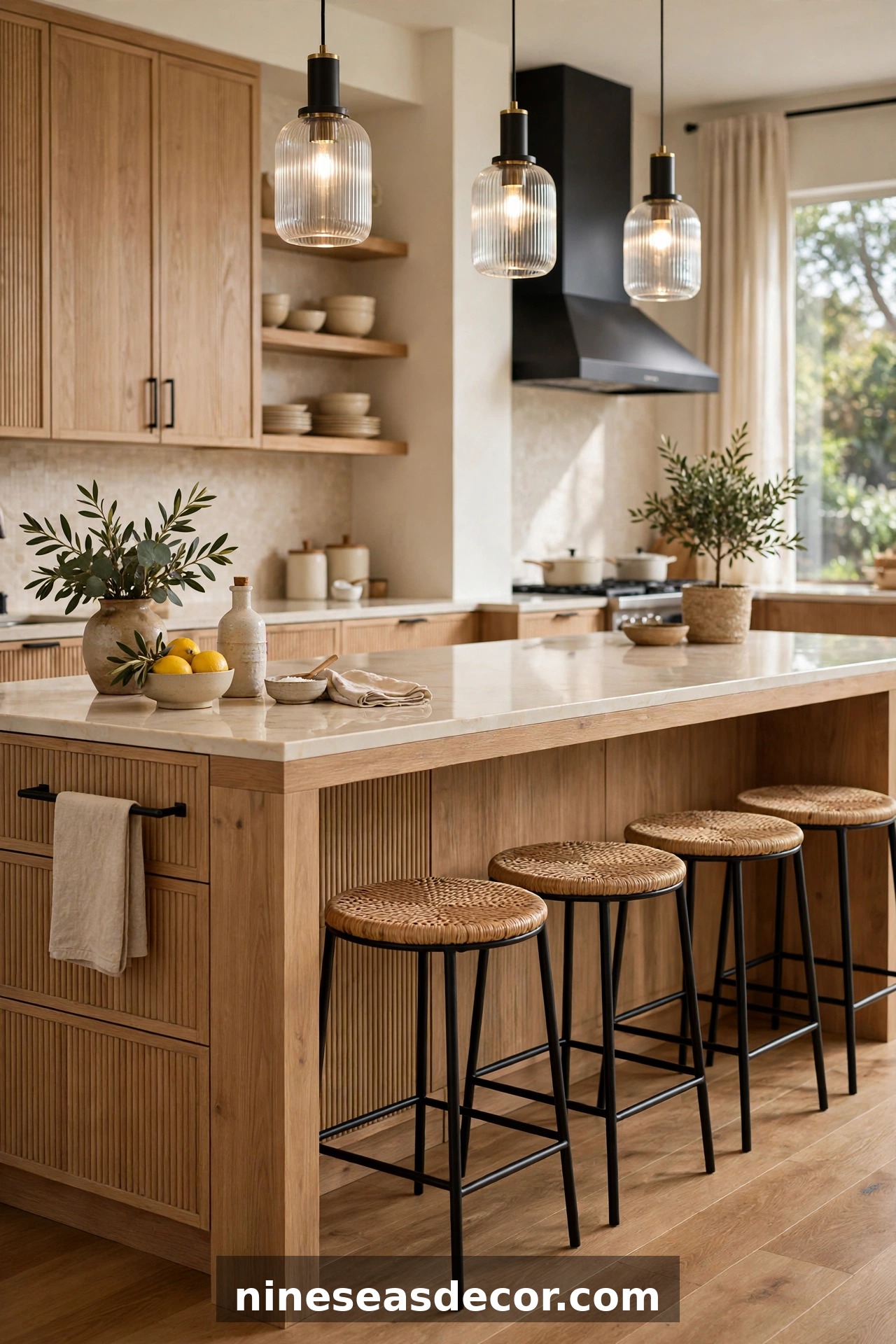
I cannot tell you how many clients come to me with seating that simply doesn’t work. Either the stools are too tall for the counter height, there isn’t enough knee clearance under the overhang, or there’s not enough width allocated per person and everyone ends up elbow to elbow like they’re on a budget airline. Island seating is a science, and when you get it right, it becomes the most used and most loved spot in your entire home.
The foundational rule is this. You need a minimum of (24 inches of width) per seat, and ideally (26 to 28 inches) for genuine comfort. You also need a minimum of (9 to 12 inches of knee clearance) between the underside of the countertop overhang and the seat of the stool. The overhang itself should be a minimum of (12 inches) for a standard counter height island, and (10 to 12 inches) for a bar height island. Get any of these numbers wrong and the seating will be uncomfortable in a way that’s hard to diagnose but impossible to ignore.
CHOOSING THE RIGHT STOOL HEIGHT FOR YOUR ISLAND
Counter height stools are for islands at (36 inches tall), and these stools should have a seat height of (24 to 26 inches). Bar height stools are for islands at (42 inches tall), and these need a seat height of (28 to 30 inches). If you have a two tier island, you’ll need bar height stools for the raised section. Always measure before you buy, and if possible, bring the stool into your kitchen and have someone sit on it before you order a full set. Seat comfort varies enormously between stools that look virtually identical. I recommend backless stools for tight spaces because they can slide fully under the counter when not in use, reclaiming that visual space. For families with young children, stools with a footrest ring are much more comfortable for smaller legs.
BUILT IN BENCH SEATING ON KITCHEN ISLANDS
Built in banquette style seating on one end of a kitchen island is a design move that I absolutely love for family kitchens. Instead of four separate stools along the length of the island, you build a low, cushioned bench into one end of the island structure. This works particularly well in corner kitchens or when the island is positioned near a wall on one end. The bench can incorporate storage underneath via lift up seat panels, which is incredibly valuable in kitchens where storage is tight. This approach also creates a cozier, more relaxed feel than a row of bar stools. You’re essentially integrating a mini breakfast nook into your island design. Cost for built in bench seating as part of an island build adds roughly ($800 to $2,500) depending on complexity and the cushion materials chosen.
HOW MANY SEATS CAN YOUR ISLAND REALISTICALLY FIT
This is a quick math exercise everyone should do before designing their island. Take the total seating length of your island (the side or end where people will sit), and divide by (26 inches). That gives you the comfortable number of seats. So a (72 inch long) island with seating along the full length can fit approximately 2.7 people, meaning a realistic maximum of (3 seats). A (96 inch long) island can comfortably seat (3 to 4 people). Don’t try to squeeze in more seats than the math allows. Uncomfortable seating that nobody uses is worse than fewer seats that everyone loves. I always recommend erring on the side of more space per person rather than more total seats.
Kitchen Island Lighting Ideas That Make The Space
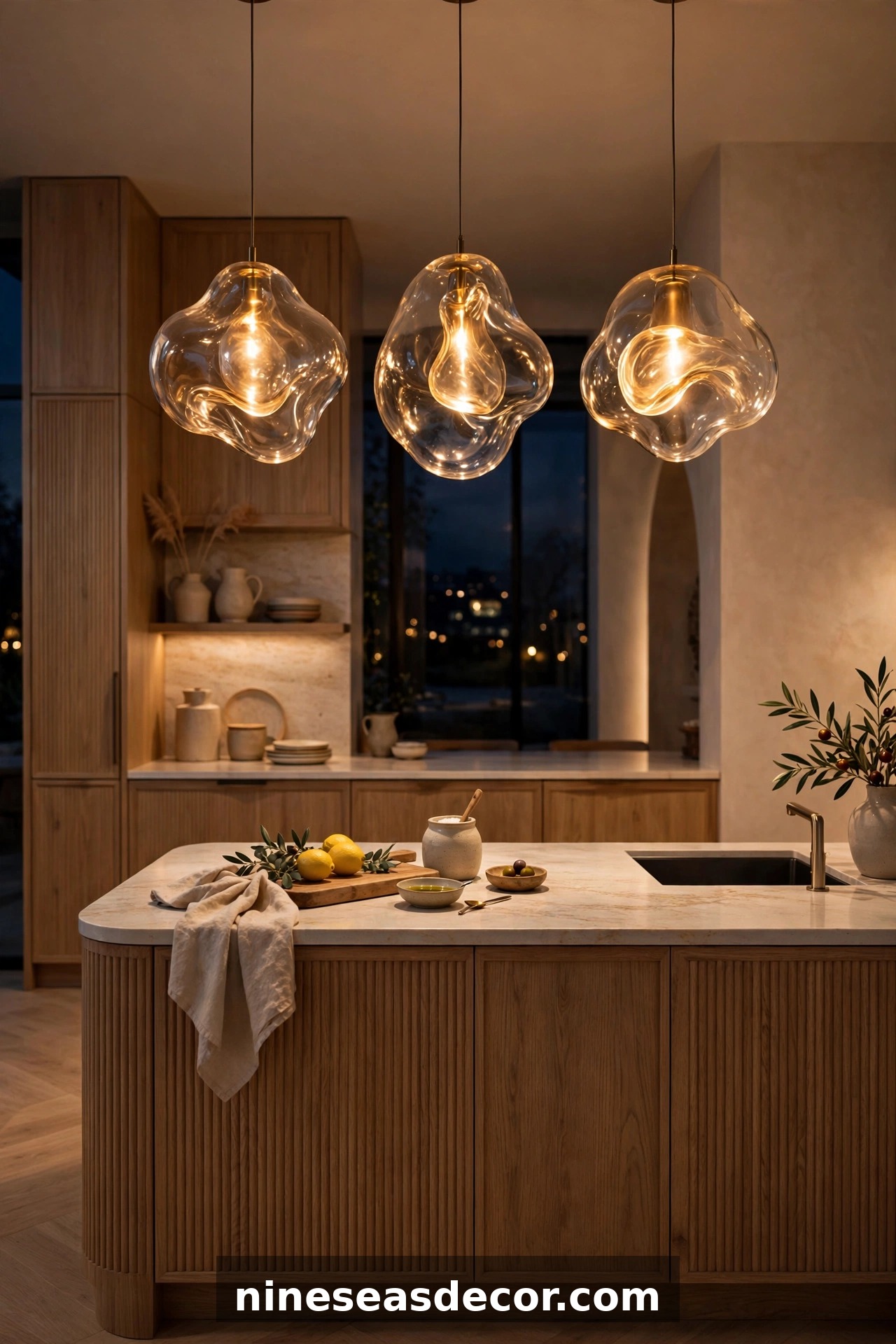
Lighting is the most underinvested element in almost every kitchen I’ve ever walked into, and it is particularly catastrophic over the island. Get this wrong and even the most beautiful island in the world will look flat, shadowy, and uninspired. Get it right and it becomes the visual anchor of the entire kitchen, the piece that photographs beautifully and makes the whole room feel designed.
The island lighting zone is where you have real creative freedom in the kitchen. While the rest of your kitchen lighting is largely functional, the pendants or fixtures over your island can be statement pieces that express personality and tie the entire room’s design together. This is the lighting equivalent of a great piece of jewelry. It’s where you invest in something that has real visual impact.
The standard rule for pendant light placement over a kitchen island is to hang the bottom of the pendant between (30 and 36 inches) above the countertop surface for standard kitchens with (8 to 9 foot ceilings). For kitchens with (10 foot or higher ceilings), you can go up to (40 inches) above the counter surface. The pendants should be centered over the island width, spaced evenly, and sized proportionally to the island length. A general rule is that the total width of your pendant fixtures should not exceed two thirds of the island length.
HOW MANY PENDANTS DO YOU NEED OVER AN ISLAND
For an island up to (48 inches long), a single large pendant or one mini pendant can work. For islands between (48 and 72 inches long), two pendants is the standard. For islands longer than (72 inches), three pendants is the most visually balanced choice. The pendants themselves should be spaced roughly (24 to 30 inches apart) from center to center, and they should be centered as a group over the island. Size wise, the individual pendant diameter should generally be between (10 and 16 inches) for a standard island. Oversized statement pendants in the (18 to 24 inch) diameter range work in larger, more dramatic spaces. Don’t mix pendant styles unless you really know what you’re doing, but do feel free to mix metals and finishes if they’re part of a cohesive design scheme you’re running through the rest of the kitchen.
RECESSED LIGHTING AND UNDER CABINET LIGHTING FOR ISLANDS
Pendant lights are the showpieces, but the functional lighting over your island also needs to be right. Make sure your electrician includes recessed can lights positioned directly over the island surface, separate from your pendant circuit. This gives you bright task lighting when you’re actually chopping and prepping, while allowing you to dim or turn off the recessed lights when you want the pendants to create ambiance. If your island has any upper cabinetry component or a raised shelf, under shelf LED strip lighting is an excellent addition. It costs as little as ($50 to $150) in materials for a DIY installation and adds remarkable warmth and utility. Always use warm white LEDs in the (2700K to 3000K) color temperature range in kitchen spaces for the most flattering and food appealing light quality.
STATEMENT LIGHTING TRENDS FOR KITCHEN ISLANDS IN 2026
The biggest lighting trends I’m seeing for kitchen islands in 2026 lean toward natural materials and sculptural forms. Rattan and woven pendant lights are huge in farmhouse and coastal kitchens. Aged brass and unlacquered brass fixtures are having a major extended moment that I don’t see slowing down. Sculptural ceramic pendants in matte earth tones (terracotta, sage, cream) are appearing in transitional and organic modern kitchens everywhere. On the more dramatic end, linear suspension lights that run the full length of the island in a single long fixture are a stunning choice for contemporary and minimalist kitchens. Budget for quality lighting from the start. A good set of two to three island pendants will run you ($300 to $1,500) for mid range options and ($1,500 to $5,000) or more for designer pieces. It’s worth every cent because it’s the first thing every single person who walks into your kitchen will notice.
Kitchen Island Storage And Function Features Worth Adding
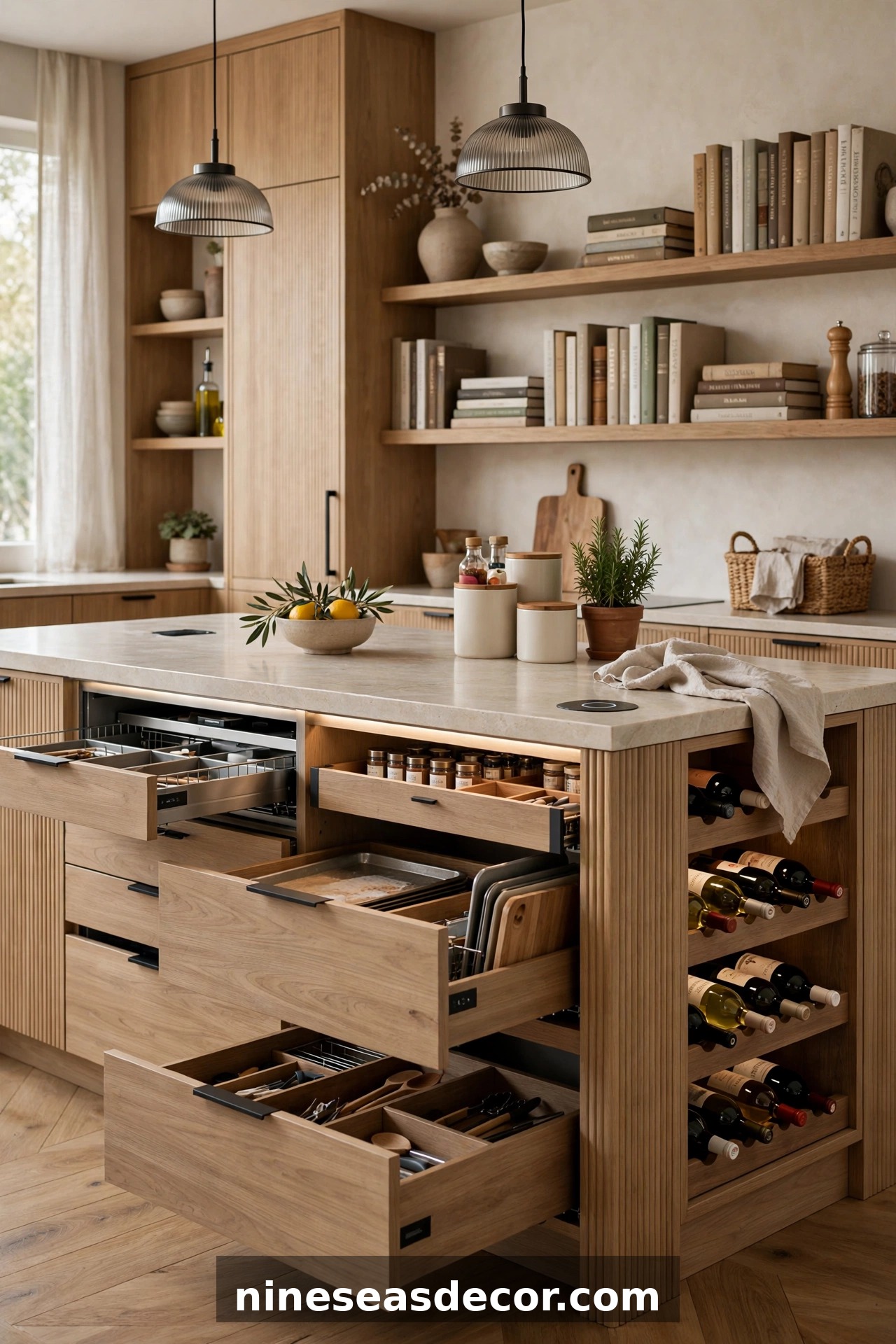
The most beautiful island in the world is wasted potential if it doesn’t also solve real organizational problems in your kitchen. This is where smart design pays off double. Every decision you make about what goes inside and underneath your island should be driven by how you actually cook, how you actually live, and what specific pain points you’re trying to solve.
I always start this conversation with clients by asking them what frustrates them most about their current kitchen. Nine times out of ten, the answers cluster around a few themes. Not enough prep space, not enough storage for pots and pans, nowhere to put the trash and recycling out of sight, no place to store wine or beverages conveniently, and awkward bottle storage. A well planned island can solve every single one of these problems simultaneously.
According to data from the National Association of Realtors (NAR) 2024 Remodeling Impact Report, kitchens with functional, well organized islands contribute to a (4 to 6% increase) in perceived home value compared to kitchens without islands, and islands with integrated appliances and storage consistently score highest in buyer appeal surveys. That’s meaningful data for homeowners who are also thinking about long term home value.
BUILT IN APPLIANCES WORTH INCLUDING IN YOUR ISLAND
The built in appliances that make the most practical sense in a kitchen island are a beverage or wine refrigerator, a warming drawer, a microwave drawer, and a dishwasher. The beverage fridge is by far the most popular choice and costs between ($500 and $2,500) for the appliance itself, plus installation. A microwave drawer is a game changer for families with children, as it moves the microwave out of arm’s reach and frees up counter or upper cabinet space. These run ($700 to $1,200) for the appliance. If your kitchen has a single dishwasher near the sink and your island is used heavily for food prep, adding a second compact dishwasher in the island is a luxury that heavy home entertainers absolutely swear by. Building an island with integrated appliances adds meaningfully to the project budget, so plan for ($3,000 to $8,000) on top of the base island cost for a well appointed appliance package.
TRASH AND RECYCLING SOLUTIONS FOR KITCHEN ISLANDS
This is the most unglamorous topic in kitchen design and also one of the most important. A pull out trash and recycling system built into your island cabinet base is one of those features that you will thank yourself for every single day. The standard configuration is a double pull out unit with one bin for trash and one for recycling, installed in a base cabinet with a minimum of (18 inches of interior width). Many homeowners are now going to a triple bin system to accommodate compost as a third category. These units run from ($150 to $600) for the pull out hardware and bins, and they’re almost always worth installing during a new island build rather than trying to retrofit later. Position the trash pull out on the side of the island closest to where you do the majority of your food prep to minimize the distance between mess creation and mess disposal.
OPEN SHELVING VERSUS CLOSED CABINETS ON ISLANDS
The debate between open shelving and closed cabinet doors on kitchen islands is a real design decision with functional implications on both sides. Open shelving on the seating side of an island creates a lighter, airier visual, allows for decorative display of beautiful bowls, cookbooks, or ceramics, and makes items easy to grab. The tradeoff is that open shelves collect dust and require everything displayed on them to be visually tidy at all times. Closed cabinet doors on the island base give you concealed storage for the messy realities of kitchen life (extra appliances, baking supplies, those sixteen reusable grocery bags you own). The best of both worlds, which I see most often in well designed kitchens, is a combination. Closed cabinets on the working side of the island and open shelves on the seating or display side. This keeps function and aesthetics both optimized.
Kitchen Island Costs: What To Budget In 2026
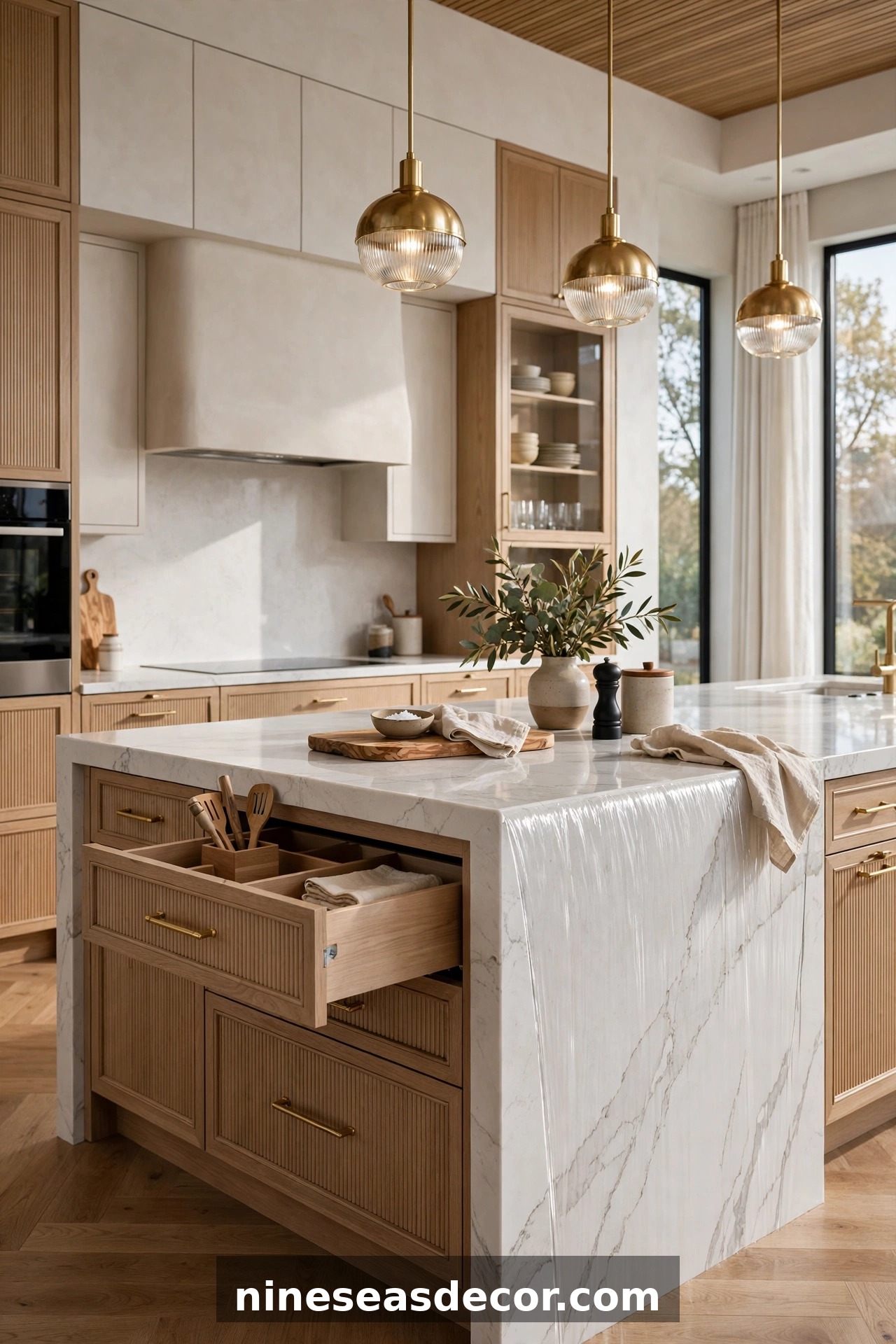
Let’s talk money, because this is where a lot of kitchen island projects either succeed or go sideways. The cost range for a kitchen island is genuinely enormous, from a ($200 rolling cart) from a big box store all the way to a ($30,000 fully custom built island) with integrated appliances, premium stone countertops, and bespoke cabinetry. Understanding what drives cost will help you make smart decisions about where to spend and where to save.
The main cost drivers are: the size of the island, the countertop material, the cabinetry quality and complexity, any plumbing (a sink in the island multiplies your cost significantly), any electrical work (for outlets, integrated appliances, and lighting), and whether you’re using a prefabricated unit or a fully custom build. Each of these variables can add or subtract thousands of dollars from your total.
PREFABRICATED ISLAND COSTS VERSUS CUSTOM BUILT ISLANDS
A quality prefabricated kitchen island from retailers like IKEA, Home Depot, or Williams Sonoma Home can run you anywhere from ($500 to $5,000) depending on size, material, and features. These are your fastest and most budget friendly options. The tradeoffs are that they come in standard sizes that may not fit your space perfectly, and they generally don’t include countertops in the price. A semi custom island built from standard cabinet boxes with custom fronts and a fabricated countertop sits in the ($3,000 to $10,000) range for a mid size island. A fully custom island built by a cabinetmaker to your exact specifications can start at ($8,000 to $15,000) and climb to ($25,000 to $40,000) or more for premium materials, integrated appliances, and complex design features. Know your budget before you start the conversation with any designer or contractor, and be completely transparent about it.
ADDING A SINK TO YOUR KITCHEN ISLAND: REAL COSTS
Adding a sink to your kitchen island is one of the most functional upgrades you can make, particularly in large kitchens where the primary sink feels far from the island work surface. But it comes with significant cost implications. Running plumbing lines to an island requires opening up your floor, running supply and drain lines, and potentially relocating a vent stack. In a kitchen with a wood subfloor, this plumbing rough in typically costs ($1,500 to $3,500) in labor alone, depending on the distance from existing plumbing and the complexity of your drain routing. Add the cost of the sink itself (($300 to $2,500) for a quality undermount sink), the faucet (($200 to $1,500)), and

Hi, I’m Sophia Rose. I believe every home tells a story. At Nine Seas Decor, I share creative ideas, budget-friendly tips, and modern trends to help you turn your living space into a sanctuary. Let’s make your home beautiful, one corner at a time!